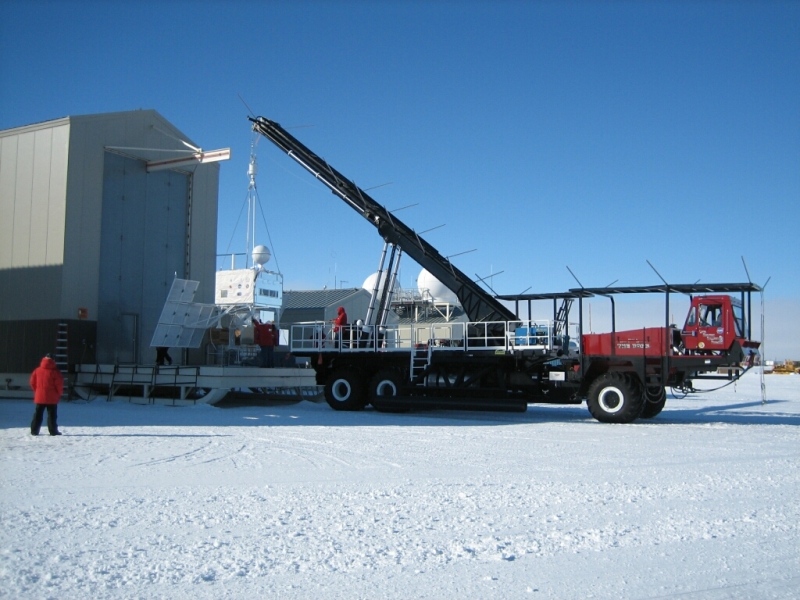
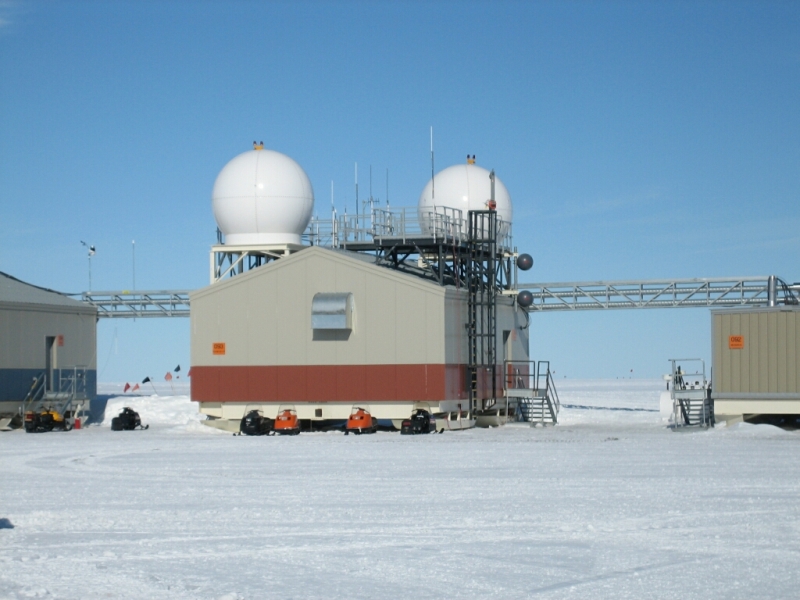
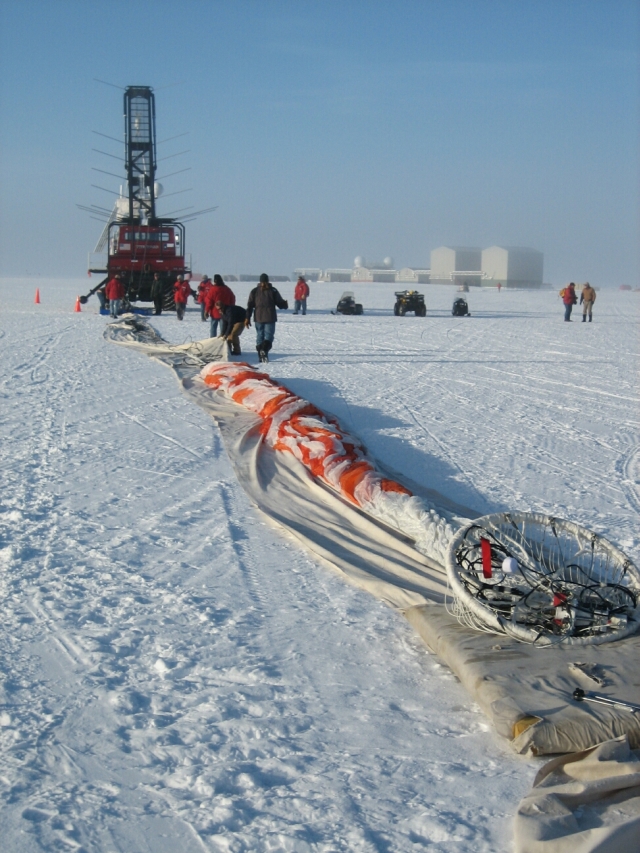
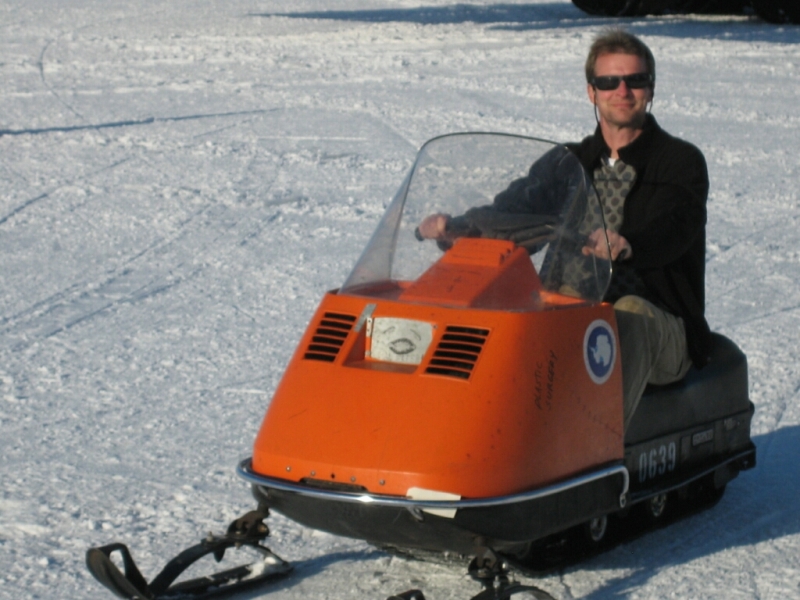
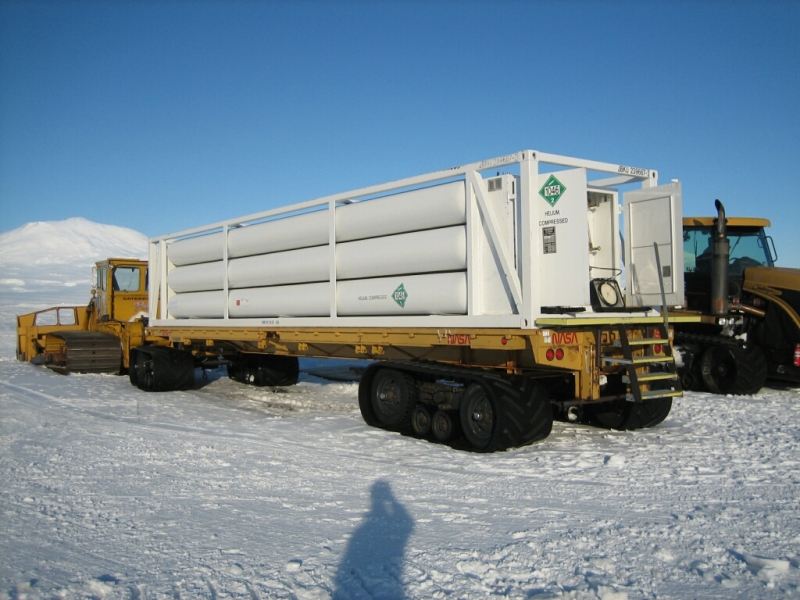
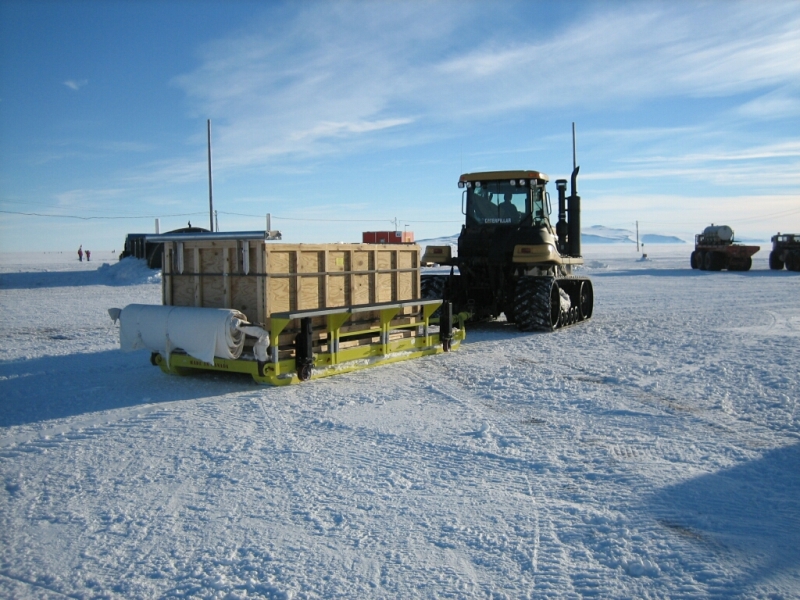
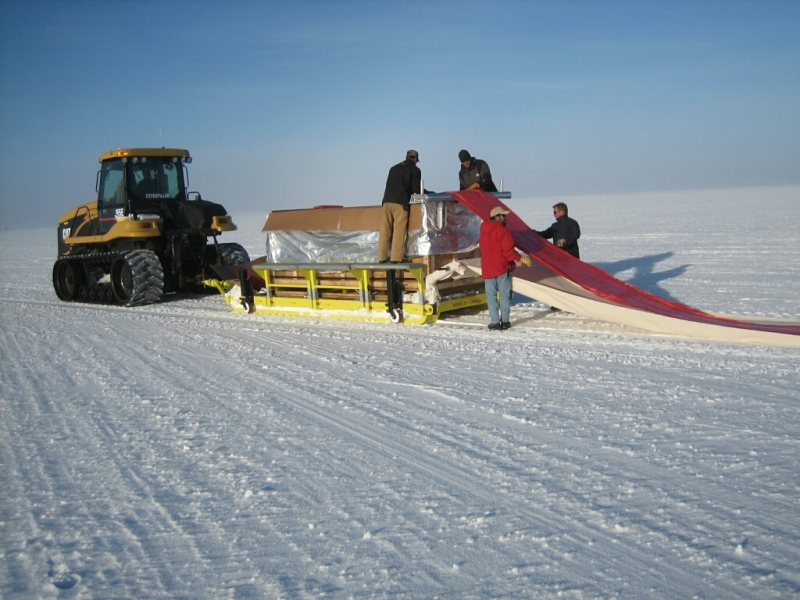
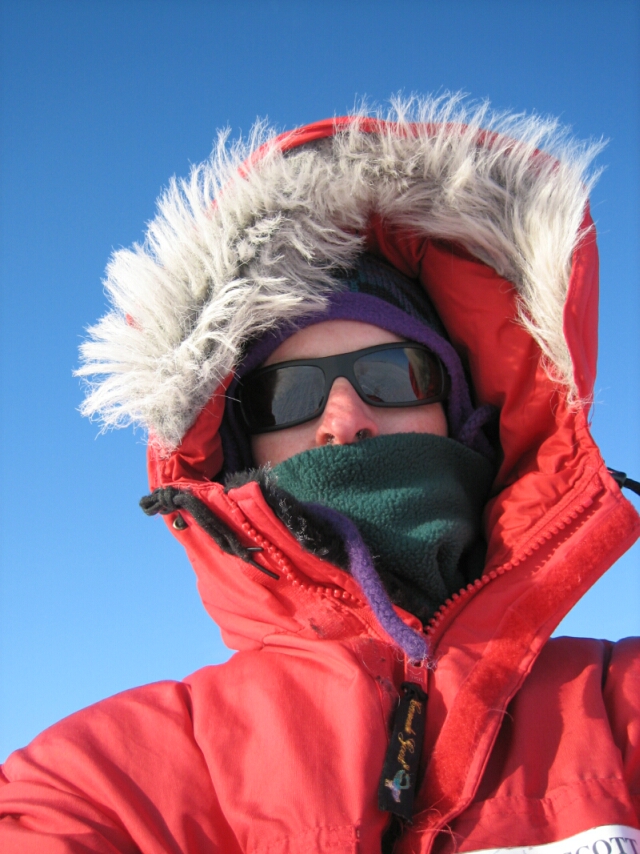
Now that the instrument has been cut down from the balloon, I am waiting for a chance to go recover it. We reuse many of the pieces in later flights. Unfortunately, the weather was bad enough early this month that there is a backlog of flights of the fixed wing craft (Twin Otters). They are mostly retrieving distant camps on some remote glacier or another, so I can't really argue with the priorities. We are far down on the totem pole. Every day since Saturday we have been the backup mission, or backup to the backup mission. Never the primary mission. When will that happen? I don't know. Hopefully soon! I need three days out in the field to completely recover the instrument. Camping is not really an option since I need three round trip flights just to carry the instrument parts, due to weight capacity limitations of the Twin Otters (the instrument weighs a total of about 6000 lbs, and the Twin Otter capacity is about 2500 lbs - four passengers take up a sizable fraction of that!). Hauling camping gear in and then out adds two more flights. It takes a lot of gear to camp safely in Antarctica. Look back at the snow school post to remember how big the Scott tents are and the number of sleeping bags and pads I used were. We will do what is called "close support," in which a Twin Otter lands next to the instrument, we work on disassembly, load the plane, and come back that same day. It makes for 14 hour days, but it beats getting stuck in a tent for a few days if bad weather moves in.
So I wait. And wait. To occupy myself I work on computer projects, IM chat with family, or utilize the local entertainment. Perhaps a post on local entertainment would be appropriate.... reading, skiing, bars, talks, and more.
Please submit comments! I never know if anyone reads this. I need assurance that this is not just an exercise in typing for me. So keep those cards and letters (in electronic form) coming!
Monday, January 21, 2008


Saturday, January 19, 2008
Swedish Icebreaker Oden
 Every year McMurdo receives several maritime visitors. First there is a fuel ship, which replenishes fuel to run the power generators for the station, the aircraft operations (which are quite massive, running people out to field camps and South Pole Station), and fuel for the South Pole generators. Then a research vessel stops by for a couple days. And finally, the resupply cargo vessel, which brings everything needed for the next year, like food, new snowmobiles, t-shirts for the store, etc. The groundwork for these visits is laid by an icebreaker, which opens up the last few miles of sea to McMurdo. For many years that duty was performed by a US Coast Guard vessel, then the contract was given to the Russians for a few years. But the last two years have seen the Swedes step in with their state of the art vessels. This year the Oden broke a channel through about 5 miles of ice up to the dock. (By the way, the dock is no more than some dirt smoothed over on top of some sea ice by the shore.) So far Oden has been in the neighborhood for two weeks. It will remain here for another two weeks to keep the channel ice free as the various other vessels arrive and depart.
The Swedes really know how to build a beautiful icebreaker. While docked here taking a break, the Oden offered tours. I was fortunate enough to be able to take one. The captain and first mate led us around. We visited the galley, bar, sauna, bridge, some crew quarters, the engine room, and walked across the deck. We learned that the shape of the bow is flat, not pointed like the classic ship, so that Oden can ride up over the ice when it crashes into it. The steel in the bow is of the finest quality and several inches thick. There are pumps that spray seawater on the ice as the bow moves over it to make it more slippery (ice has more and more friction as it gets colder). Once the icebreaker has ridden up on the ice, it breaks it by rocking from side to side. Rocking? What, do all hands leap from side to side? No! There are water tanks in each side of the ship and a massive pumping system that can change the heel of the boat by 20 degrees in 20 seconds. The ship has four eight cylinder diesel engines directly coupled to the two propeller shafts (usually the engines run an electric motor which then runs the propellers), and can go from full reverse to full forward in 12 seconds. I am told she stands on her stern when that happens. Must be quite exciting. The interior is beautifully decorated with wood highlights, and each of the crew of 18 gets his or her own room. Visiting scientists, however, have to share four to a room.
There is probably more information online, but I have not taken the effort to search for it. If anyone finds a link to more about the Oden, send it along and I'll put it in this post.
Thursday, January 17, 2008
Youtube video of Snow School available!
The time lapse video of my Snowcraft School class building a snow wall out on the ice shelf has been posted to Youtube. I'm the one in black with a red hat that ends up hauling sleds with snow blocks on it. I am not sure if either the link above or embedded video below work because our bandwidth here is extremely limited. If it is not working, search Youtube for "Happy Campers from McMurdo build snow wall." I send my thanks to my son Joe for getting this online.
Burning questions:
"Is McMurdo a science town with a drinking problem or a drinking town with a science problem?"
"From an evolutionary perspective, why have women lost the ability to grow a beard? It sure would be useful down here" I think this one goes next to "Why do men have nipples?" Your opinion is welcome. Perhaps an intelligent dialogue is possible through the comments. Or not.
Burning questions:
"Is McMurdo a science town with a drinking problem or a drinking town with a science problem?"
"From an evolutionary perspective, why have women lost the ability to grow a beard? It sure would be useful down here" I think this one goes next to "Why do men have nipples?" Your opinion is welcome. Perhaps an intelligent dialogue is possible through the comments. Or not.
Wednesday, January 16, 2008
TERMINATE!
 To paraphrase the Daleks of Dr Who fame, TERMINATE! Termination of the CREAM flight has occurred successfully during a textbook perfect mission. I went along as resident scientist/tourist on an LC130 ride. The termination is a CSBF operation, and I congratulate them on an excellent job.
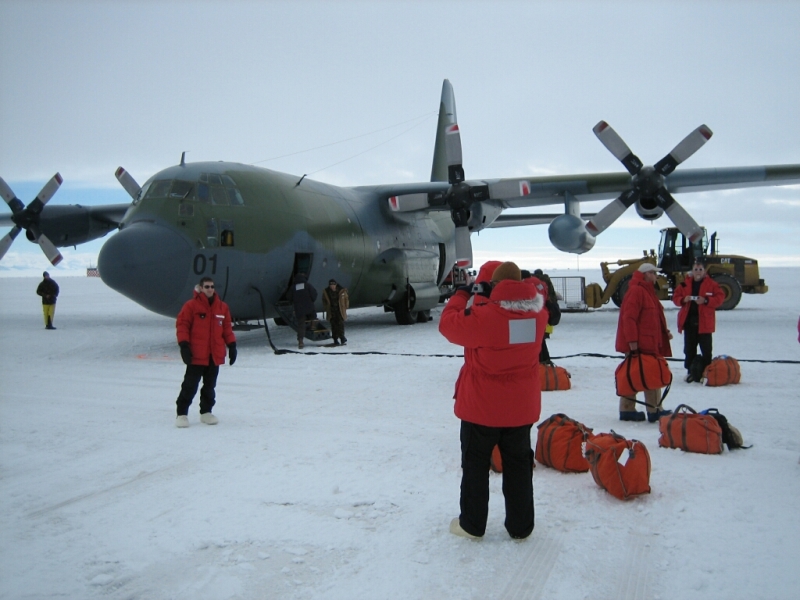
We took an LC130 (notice the skis for wheels) at about noon today and flew about 200 miles along the Ross Ice Shelf east of McMurdo. I have never see the 200 foot tall ice shelf edge before and was amazed at its beauty. We then flew in about 65 miles to the balloon location. CSBF terminated the flight, which means they separated the CREAM instrument with parachute from the balloon, pulled the rip cord on the balloon to release the helium and let it free fall, and circled as the payload parachuted to the ice. The parachute separated from the payload nicely after touching down, and ended up on its side. The balloon landed after its free fall less than a few miles from the payload. I was back in McMurdo by 5 PM.


I never was worried about the ride getting wild. My sailing experience helped me keep my feet (and stomach). We do not know when the recovery effort will begin yet.
Tuesday, January 15, 2008
Latest news
The CREAM payload is very close to being cut down. It will happen within the next couple of days. The call to do it is out of my hands, and in the hands of the Columbia Scientific Balloon Facility (CSBF) representative here.  My role in the cut down is that of tourist. If we take the larger C130 I can ride along, but if a smaller Twin Otter plane is taken there will not be room for me. Going along would be a mixed blessing, I think. I am told that it is a roller coaster ride - lots of high g-force turns and vomit-inducing twists as the pilots circle to keep the payload in sight and scope out the landing area, with low altitude flyovers. I would be in the back of the plane in a moderately windowless environment so could potentially get airsick. I am told I should keep a few barf bags handy. But hey, you rarely get this kind of opportunity, so what the heck.
After our two days of blue sky, the weather has again turned poor - nothing new in that respect in this season full of bad weather. There is snow again, and a low ceiling, which makes a series of low altitude flying during cut down more likely. I have included a photo of Derilict Junction, the "main square" in McMurdo, with Ivan the TerraBus making its way to the bus stop so you can see the grey and snow.
By the way, you can make a comment by pressing the "comments" button below. Don't be shy! I would love to hear from you.
 My role in the cut down is that of tourist. If we take the larger C130 I can ride along, but if a smaller Twin Otter plane is taken there will not be room for me. Going along would be a mixed blessing, I think. I am told that it is a roller coaster ride - lots of high g-force turns and vomit-inducing twists as the pilots circle to keep the payload in sight and scope out the landing area, with low altitude flyovers. I would be in the back of the plane in a moderately windowless environment so could potentially get airsick. I am told I should keep a few barf bags handy. But hey, you rarely get this kind of opportunity, so what the heck.
After our two days of blue sky, the weather has again turned poor - nothing new in that respect in this season full of bad weather. There is snow again, and a low ceiling, which makes a series of low altitude flying during cut down more likely. I have included a photo of Derilict Junction, the "main square" in McMurdo, with Ivan the TerraBus making its way to the bus stop so you can see the grey and snow.
By the way, you can make a comment by pressing the "comments" button below. Don't be shy! I would love to hear from you.
People in McMurdo
The talent collected at McMurdo amazes me. There is a cross section of people from all walks of life. All are attracted by the prospect of either living in Antarctica or doing science here. The Station has a mixture of scientists and support personnel. The support folk perform the heroic task of keeping things running here, and have jobs ranging from janitor, cook, galley slave, and hair stylist, to helicopter pilot, shuttle driver, hazardous waste supervisor, mechanic, and sewage plant operator, etc – everything a small town needs to be completely self sufficient. The support people here all have a story. Some can fix anything, including the 50 year old trucks and other equipment originally brought here by the Navy during the establishment of McMurdo. Others just want to be here. The standard story line is “PhD? No big deal. We have PhD’s working in the galley!” There are mountaineers that support the field camps that were guides on Denali. While some people consider the pinnacle of their climbing careers to peak a mountain like Denali, these people guided folks to the peaks regularly. You also get some of the best scientists in geology, biology, glaciology, astrophysics, and more down here all mixing together. There is an Air National Guard unit that operates the flights to and from here and the flights to many of the more distant field camps, including South Pole Station. They have fuel handlers, mechanics, doctors, pilots, navigators, psychologists…. quite a list. Everyone meets in the galley for breakfast, lunch, and dinner. Real synergy!
Snow School, aka Happy Camper
If you are going out to the field in Antarctica from McMurdo Station, no matter for how long, you have to be trained in how to camp on the ice. Since lots and lots of people come through McMurdo on their way to a field camp, a whole culture has sprung up around the Snowcraft Class, aka Happy Camper.
Happy Camper involves learning how to set up a Scott tent (a floorless four-pole tent ideal for arctic conditions), cook on the camp stoves, using the snow to build shelters, helicopter and radio etiquette (including shortwave), and emergency procedures. We also discuss proper clothing. The basic guideline: no cotton touching the skin. If you are active, you sweat, and you need to wick away that moisture or you will get cold the next time you are inactive. The gear issue provides everything you need, including long underwear, to survive in these temperatures.
Twelve people were in this particular offering of the class, including a few people working support staff at McMurdo. This is a special opportunity for them because they don’t get out much compared to the scientists. They actually treat this as recreation. Frankly, I think Happy Camper should be renamed “Digging School.” I have not done this much digging and hauling for a looong time.
An arctic camp is only partly tents. Since the winds down here can be pretty brutal, and shelter is non-existent out on the ice, we have to make our own. We built a few snow walls from snow blocks quarried from the snow pack on top of the permanent ice shelf, and dug a kitchen area inside the protected area, so that we could cook our water. All we ate was freeze dried food and granola bars. Freeze dried food is very unsatisfying, and not recommended for an extended period of time if you want to keep your digestion intact. We are always told that people in the filed lose weight because of the body combating the cold, but I think it is because no one can stomach the freeze dried beef stroganoff. At least we had an awesome kitchen to eat it in (see photo).
We also built a quinzee hut. To build this, first choose a spot on the edge of the sheltered area you have created with the snow walls and Scott tents. Pile up all your gear (sleeping bags and pads, extra clothing bags, etc) in a mound, then shovel tons of snow onto it. Pat down the snow several times as you pile. Let set for a few hours. Dig a small hole at ground level and start pulling out the gear, leaving a hollow inside. From the side facing the compound of tents, start an entry hole by digging down, then up into the open space left by the gear. This will keep the warm air, which rises, from escaping out a ground level hole. After completing the entry hole, block off the gear removal hole with a few quarried snow blocks, lay out your pads and sleeping bags and enjoy! While I did not sleep in there, I hear that it was comfortably warm, room enough for two, but you had to be careful when sitting up not to bump the walls and knock down snow. Here is a picture of us building the quinzee hut. The Scott tents are the yellow-orange things.
I am trying to get a time lapse video of building one of the snow walls on Youtube but am having trouble getting the upload to work on the Cincinnati side. There is not enough bandwidth down here to upload via Youtube’s html loader, so I had to get the video Stateside in a roundabout way. Without going into details, just stay tuned….
We took particular care to do a good job on all this because we then spent the night in our creations. The Scott tent, where I stayed, was quite comfortable. I was, in fact, overly warm on my two pads and in my two sleeping bags. One of the best investments you can make for the night is a pee bottle. We’ll just leave that at that….
I had a pretty good time out there. The weather was grey and snowy, with blustery winds. For a short time the following day visibility was down to a couple hundred yards due to blowing snow. These were perfect conditions for some of the scenarios we ran, such as how to find a missing person during white out conditions – not easy! There is another picture of trying to pull out the person who went into the hut to try to yank the buried gear out and got kind of stuck!
 Our finished camp looked like this picture. Look for the three snow walls around the Scott tents - left, right, and center; the quinzee hut to the left, and the mountain tents behind all our sleeping gear.
I also took a class about how to recognize, avoid, and deal with altitude sickness. The ice is so thick that the altitude of much of the continent is over 8000 feet. I may end up in an area that high for recovery. Too soon to tell at this point, though.
Happy Camper involves learning how to set up a Scott tent (a floorless four-pole tent ideal for arctic conditions), cook on the camp stoves, using the snow to build shelters, helicopter and radio etiquette (including shortwave), and emergency procedures. We also discuss proper clothing. The basic guideline: no cotton touching the skin. If you are active, you sweat, and you need to wick away that moisture or you will get cold the next time you are inactive. The gear issue provides everything you need, including long underwear, to survive in these temperatures.
Twelve people were in this particular offering of the class, including a few people working support staff at McMurdo. This is a special opportunity for them because they don’t get out much compared to the scientists. They actually treat this as recreation. Frankly, I think Happy Camper should be renamed “Digging School.” I have not done this much digging and hauling for a looong time.
An arctic camp is only partly tents. Since the winds down here can be pretty brutal, and shelter is non-existent out on the ice, we have to make our own.
 We built a few snow walls from snow blocks quarried from the snow pack on top of the permanent ice shelf, and dug a kitchen area inside the protected area, so that we could cook our water. All we ate was freeze dried food and granola bars. Freeze dried food is very unsatisfying, and not recommended for an extended period of time if you want to keep your digestion intact. We are always told that people in the filed lose weight because of the body combating the cold, but I think it is because no one can stomach the freeze dried beef stroganoff. At least we had an awesome kitchen to eat it in (see photo).
 We also built a quinzee hut. To build this, first choose a spot on the edge of the sheltered area you have created with the snow walls and Scott tents. Pile up all your gear (sleeping bags and pads, extra clothing bags, etc) in a mound, then shovel tons of snow onto it. Pat down the snow several times as you pile. Let set for a few hours. Dig a small hole at ground level and start pulling out the gear, leaving a hollow inside. From the side facing the compound of tents, start an entry hole by digging down, then up into the open space left by the gear. This will keep the warm air, which rises, from escaping out a ground level hole.
 After completing the entry hole, block off the gear removal hole with a few quarried snow blocks, lay out your pads and sleeping bags and enjoy! While I did not sleep in there, I hear that it was comfortably warm, room enough for two, but you had to be careful when sitting up not to bump the walls and knock down snow. Here is a picture of us building the quinzee hut. The Scott tents are the yellow-orange things.
 I am trying to get a time lapse video of building one of the snow walls on Youtube but am having trouble getting the upload to work on the Cincinnati side. There is not enough bandwidth down here to upload via Youtube’s html loader, so I had to get the video Stateside in a roundabout way. Without going into details, just stay tuned….
We took particular care to do a good job on all this because we then spent the night in our creations. The Scott tent, where I stayed, was quite comfortable. I was, in fact, overly warm on my two pads and in my two sleeping bags. One of the best investments you can make for the night is a pee bottle. We’ll just leave that at that….
I had a pretty good time out there.
 The weather was grey and snowy, with blustery winds. For a short time the following day visibility was down to a couple hundred yards due to blowing snow. These were perfect conditions for some of the scenarios we ran, such as how to find a missing person during white out conditions – not easy! There is another picture of trying to pull out the person who went into the hut to try to yank the buried gear out and got kind of stuck!
  Our finished camp looked like this picture. Look for the three snow walls around the Scott tents - left, right, and center; the quinzee hut to the left, and the mountain tents behind all our sleeping gear.
I also took a class about how to recognize, avoid, and deal with altitude sickness. The ice is so thick that the altitude of much of the continent is over 8000 feet. I may end up in an area that high for recovery. Too soon to tell at this point, though.
Monday, January 14, 2008
The story thus far
I arrived on January 5, 2008. A lot has happened since then. Let’s see if I can catch you up:
1. Weather – Pretty miserable until the last couple of days. Nothing but grey sky, and very cold relative to my visit in December 2005. We had one big snow storm (named Julia) that dumped almost a foot of snow on us. (It's hard for me to tell how much since the wind left many drifts around the Station.) Flights to field camps were cancelled, and the Station nearly came to a halt. After the storm abated it took an extra day just to clear the runways and roads enough to resume traffic.
2. Snow school – Anyone who may be going into the field has to take an overnight training course to learn how to camp in Antarctic conditions. We quarried snow blocks and built snow walls, and fabricated a quinzee hut as well, which is sort of lazy man's igloo. (Other - incorrect- spellings of quinzee include "quinsy" and "quincy" and "quinsey.") I’ll make a post to tell you more about that. I also had training required of everyone: Environmental Protection (a biggy down here), and Outdoor Safety, required of anyone who wants to take a hike.
3. Icebreaker Oden – Every year the last few miles of ice are broken out so that the cargo vessel can come into port. While this job was originally performed by American vessels, it was contracted out to the Russians for a few years and for the last two years it has been done by the Swedish icebreaker Oden. A beautiful boat. I will make a short post about my tour of it.
4. The experiment – For the first time, a total of three balloons were launched this year. They are all making two revolutions around the Pole. The last one launched (ATIC) is being cut down today. It has spiraled into the Pole, and recovery of the instrument will be coordinated from there. My experiment, CREAM, the first one launched, has nearly completed two revolutions and will be cut down on Wednesday or Thursday, probably over the Ross Ice Shelf near McMurdo, but the surface weather is not supposed to be very good so it might get delayed. The last one to be terminated, BESS, was the second balloon launched but is still 5 or 6 days out from completing its second revolution. You can follow the paths of these balloons at the NASA CSBF site for Antarctic operations.
1. Weather – Pretty miserable until the last couple of days. Nothing but grey sky, and very cold relative to my visit in December 2005. We had one big snow storm (named Julia) that dumped almost a foot of snow on us. (It's hard for me to tell how much since the wind left many drifts around the Station.) Flights to field camps were cancelled, and the Station nearly came to a halt. After the storm abated it took an extra day just to clear the runways and roads enough to resume traffic.
2. Snow school – Anyone who may be going into the field has to take an overnight training course to learn how to camp in Antarctic conditions. We quarried snow blocks and built snow walls, and fabricated a quinzee hut as well, which is sort of lazy man's igloo. (Other - incorrect- spellings of quinzee include "quinsy" and "quincy" and "quinsey.") I’ll make a post to tell you more about that. I also had training required of everyone: Environmental Protection (a biggy down here), and Outdoor Safety, required of anyone who wants to take a hike.
3. Icebreaker Oden – Every year the last few miles of ice are broken out so that the cargo vessel can come into port. While this job was originally performed by American vessels, it was contracted out to the Russians for a few years and for the last two years it has been done by the Swedish icebreaker Oden. A beautiful boat. I will make a short post about my tour of it.
4. The experiment – For the first time, a total of three balloons were launched this year. They are all making two revolutions around the Pole. The last one launched (ATIC) is being cut down today. It has spiraled into the Pole, and recovery of the instrument will be coordinated from there. My experiment, CREAM, the first one launched, has nearly completed two revolutions and will be cut down on Wednesday or Thursday, probably over the Ross Ice Shelf near McMurdo, but the surface weather is not supposed to be very good so it might get delayed. The last one to be terminated, BESS, was the second balloon launched but is still 5 or 6 days out from completing its second revolution. You can follow the paths of these balloons at the NASA CSBF site for Antarctic operations.
Sunday, January 13, 2008
I'm Baaaack!
Yes, I am back in McMurdo. This time I am here in January instead of December. There should be many differences: the weather is colder, and the ice breaker is coming, along with the cargo vessel. There could be penguins and Weddell seals.
My job is different this time. It is now to go out into the field and recover the CREAM instrument instead of help prepare it for flight. This is a great opportunity for me - it means I will get to see something of the Antarctic continent! Typically the instrument comes down on the Ross Ice Shelf or on the Antarctic plateau behind the TransAntarctic Mountains near Ross Island where McMurdo is. I will fly out to the site and over the course of a few days disassemble the instrument, have it flown back in pieces to McMurdo, pack everything carefully into large shipping containers, and then have it shipped back to the States on the cargo vessel due here in the next couple of weeks.
This year three cosmic ray balloon experiments were launched: CREAM, BESS, and ATTIC. You can follow the progress of each experiment at the NASA Challenger Scientific Balloon Facility Antarctic Operations site. At this time CREAM (my experiment) is nearly finished with its second revolution, and we are in the process of trying to decide about a third revolution.
I arrived about a week ago (Jan 5, 2008), and had not decided to continue this blog. However, enough interesting things have happened that I think it is worthwhile to document some of them. Keep tuning in!
You can learn a lot about McMurdo Station from the posts in this blog from my previous visit, in December 2005. they are linked in the archive listings in the sidebar.
My job is different this time. It is now to go out into the field and recover the CREAM instrument instead of help prepare it for flight. This is a great opportunity for me - it means I will get to see something of the Antarctic continent! Typically the instrument comes down on the Ross Ice Shelf or on the Antarctic plateau behind the TransAntarctic Mountains near Ross Island where McMurdo is. I will fly out to the site and over the course of a few days disassemble the instrument, have it flown back in pieces to McMurdo, pack everything carefully into large shipping containers, and then have it shipped back to the States on the cargo vessel due here in the next couple of weeks.
This year three cosmic ray balloon experiments were launched: CREAM, BESS, and ATTIC. You can follow the progress of each experiment at the NASA Challenger Scientific Balloon Facility Antarctic Operations site. At this time CREAM (my experiment) is nearly finished with its second revolution, and we are in the process of trying to decide about a third revolution.
I arrived about a week ago (Jan 5, 2008), and had not decided to continue this blog. However, enough interesting things have happened that I think it is worthwhile to document some of them. Keep tuning in!
You can learn a lot about McMurdo Station from the posts in this blog from my previous visit, in December 2005. they are linked in the archive listings in the sidebar.
Wednesday, January 18, 2006
REALLY the Last Post
So, just to tie up some loose ends…. The balloon came down on January 13, 2006, only 250 miles from where it was launched. It made two complete revolutions around Antarctica, and stayed up for about 32 days. CREAM is the luckiest experiment I have ever been on. Recovery was easy and total. Absolutely everything was recovered, and very quickly, in a couple days and a few flights.
As for the beard: I shaved it off on Monday, January 16. I was tired of wringing out my face every time it got wet. The beard never really got soft, so always itched, and my wife never really stopped laughing. I shaved it off in stages, intending to stop for a while at various places, but as soon as I shaved off the first part, I could not stop, because it looked ridiculous. A goatee and/or sideburns are not my style.
So, thanks for tuning in. My journey and this blog were featured in a local newspaper article in the Cincinnati Enquirer (Northern Kentucky edition). My 15 minutes of fame have come and gone.
I did decide that I want to make this once in a lifetime opportunity into a twice in a lifetime opportunity, and I think I have that chance. In fact, I think I have two chances. Once again with the CREAM experiment in 2007/08, and again the following year with CREST. All this, of course, depends on various schedules happening as planned. My fingers are crossed!!
As for the beard: I shaved it off on Monday, January 16. I was tired of wringing out my face every time it got wet. The beard never really got soft, so always itched, and my wife never really stopped laughing. I shaved it off in stages, intending to stop for a while at various places, but as soon as I shaved off the first part, I could not stop, because it looked ridiculous. A goatee and/or sideburns are not my style.
So, thanks for tuning in. My journey and this blog were featured in a local newspaper article in the Cincinnati Enquirer (Northern Kentucky edition). My 15 minutes of fame have come and gone.
I did decide that I want to make this once in a lifetime opportunity into a twice in a lifetime opportunity, and I think I have that chance. In fact, I think I have two chances. Once again with the CREAM experiment in 2007/08, and again the following year with CREST. All this, of course, depends on various schedules happening as planned. My fingers are crossed!!
Monday, January 02, 2006
Last Post... Vote Now!
I made several predictions when I made my first post on this blog. Let’s see how those turned out:
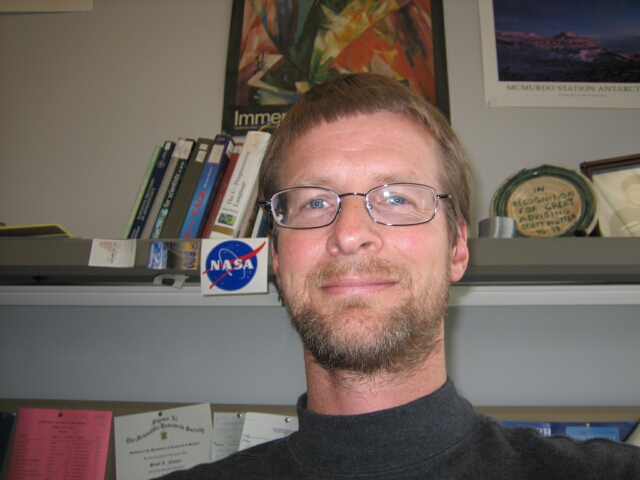
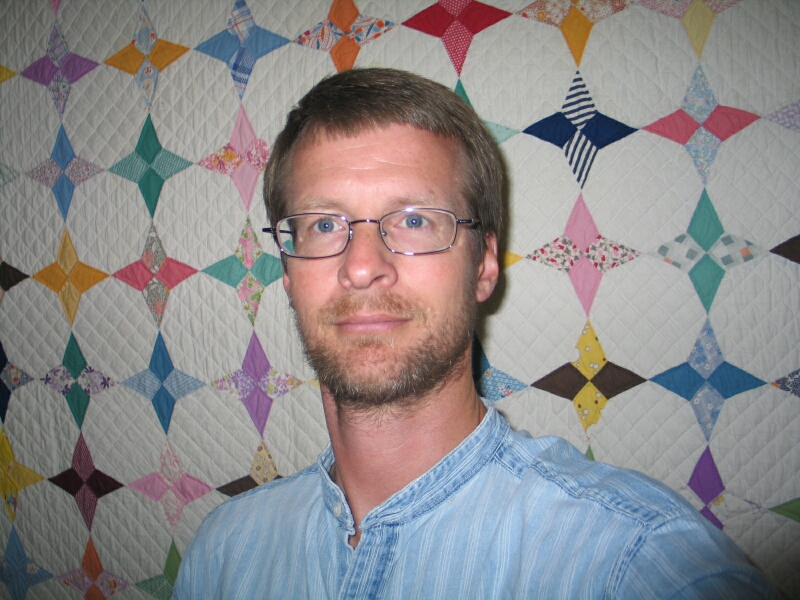
Alright, I need your help. What’s the word on the beard? Compare this picture to the one in the sidebar to the right. Does it fit me, or should I go back to being clean shaven? Vote in the comments.
To answer a few of the more interesting questions posted as responses to previous blogs:
The official time zone of McMurdo is New Zealand time, which makes sense since McMurdo is nearly due south of NZ.
The toilet seats for the outdoor pit toilets are Styrofoam. The toilet doors don’t always lock, so there is a red flag that says “STOP” in the room which you place outside the door when you are inside.
The CREAM detector is currently floating between 125,000 and 130,000 feet, a perfect altitude.
- I’ll grow a beard. Yup. Check out the four weeks growth. I think I’ll keep it for another month or so just to see what happens. The downside is that my wife isn’t really a fan. She says she wonders who this stranger is that she picked up at the airport. Fortunately for me, she still agrees to kiss the stranger, but usually breaks out in laughter in the middle. She calls herself “long-suffering….”
- I will spend all my time schmoozing while down on the Ice instead of all the work I am hoping to accomplish. So true. I got very little of the work done that I took with me, but I did revisit my pool game skills (there are two pool tables in McMurdo).
- I will have far more cold weather gear than I need. Oh yeah. I hauled around a bunch of junk. Staying at Mcmurdo did not strain my wardrobe like going out in the field would have.
- I will have far more entertainment items (books, DVDs, music) than I need. Yes, but not by much. I finished off three of the four books and watched two of the three movies I took.
- I will wish I had more time in NZ. Yes, yes, yes!!!
- I will not meet Peter Jackson. Nope. Not a sight. But I probably wouldn’t recognize him anyway because he lost a lot of weight. He could have been on the same sea kayaking trip I was on and I wouldn’t have known.
- I will gain 10 pounds. Yes, there was a full hot breakfast every morning, and staying at B&Bs did not help. Actual weight gain: 7 pounds.
Alright, I need your help. What’s the word on the beard? Compare this picture to the one in the sidebar to the right. Does it fit me, or should I go back to being clean shaven? Vote in the comments.
To answer a few of the more interesting questions posted as responses to previous blogs:
The official time zone of McMurdo is New Zealand time, which makes sense since McMurdo is nearly due south of NZ.
The toilet seats for the outdoor pit toilets are Styrofoam. The toilet doors don’t always lock, so there is a red flag that says “STOP” in the room which you place outside the door when you are inside.
The CREAM detector is currently floating between 125,000 and 130,000 feet, a perfect altitude.
Exploring New Zealand
What an incredible place New Zealand is! There is a little bit of paradise there. The country consists of two large islands, called the North and South Islands by natives, though they must have real names. Auckland, the capital, is on the North Island, and contains fully half the country’s population of about 4 million. As a result the rest of the country is pretty empty, especially the South Island. I only toured the north end of the South Island.
Before I get into the details of my NZ trip, I though I should give a few travel tips for the next time you go down there. First of all, if you get a car, be prepared to drive on the left side of the road. (My mantra for right turns was “Go right, stay left.”) Car travel times are much longer for a particular distance than you would expect in the States. There are no four lane roads (at least where I was), and although there is no traffic to speak of even during this busy holiday period, the roads are quite twisty and turny so travel is slow. Similarly, on the trails, signs posted to help the hiker time his day give times for walks that are ridiculously short. I am no slacker, but I would have had to practically jog to match the suggested times!
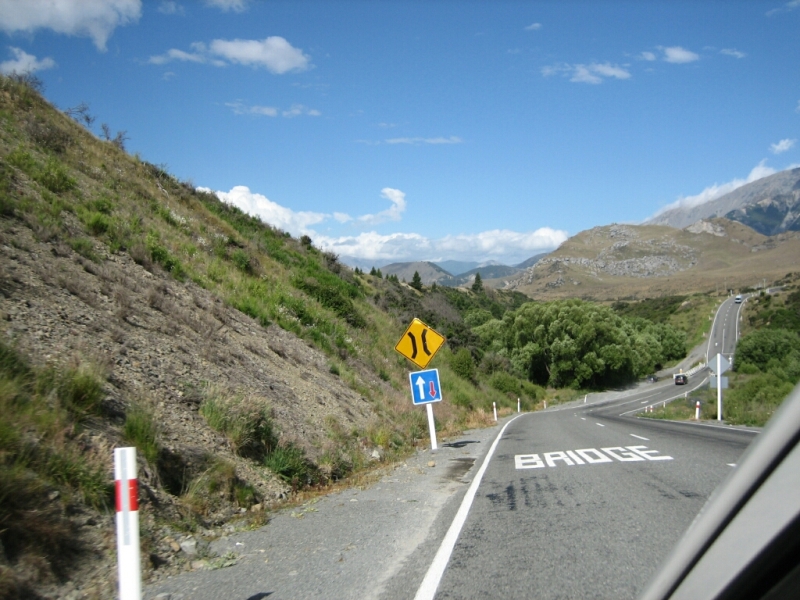
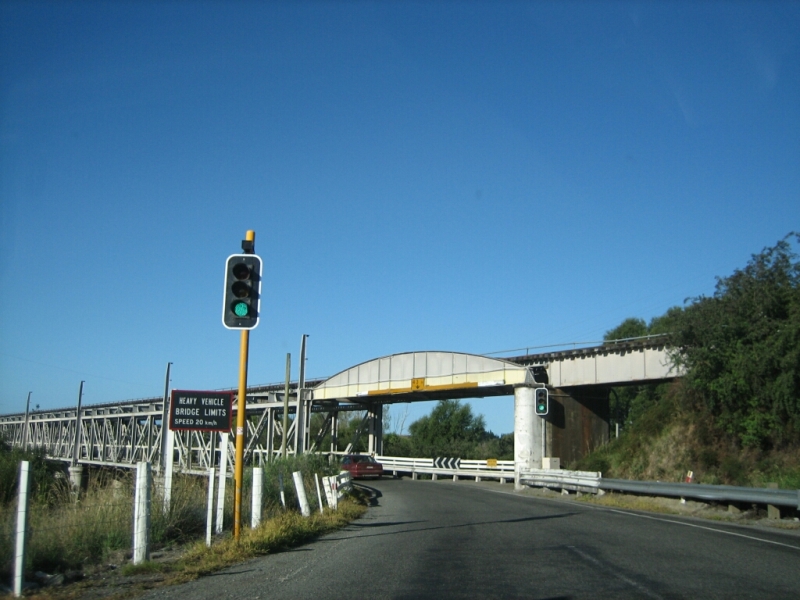
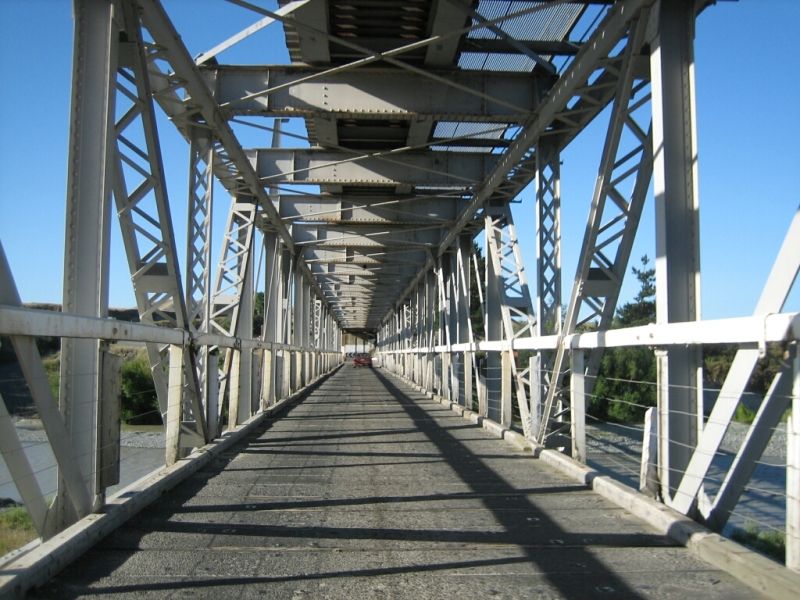
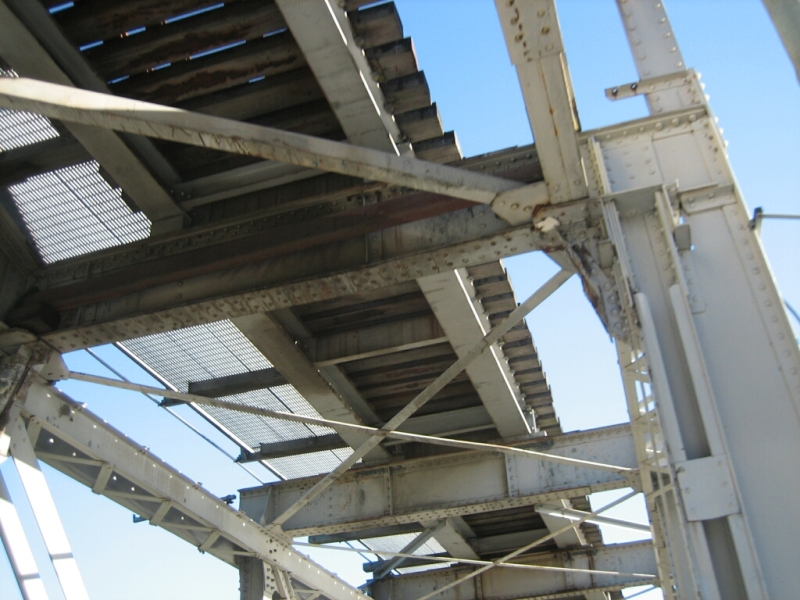
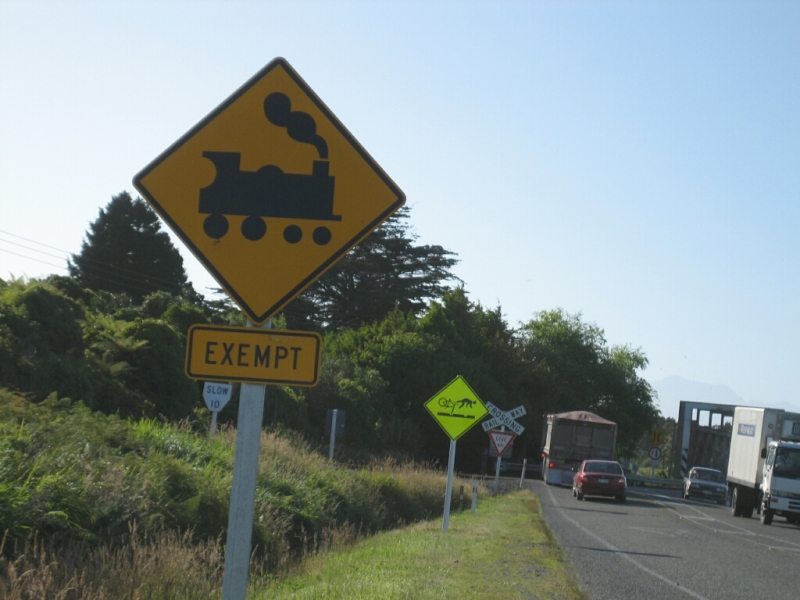
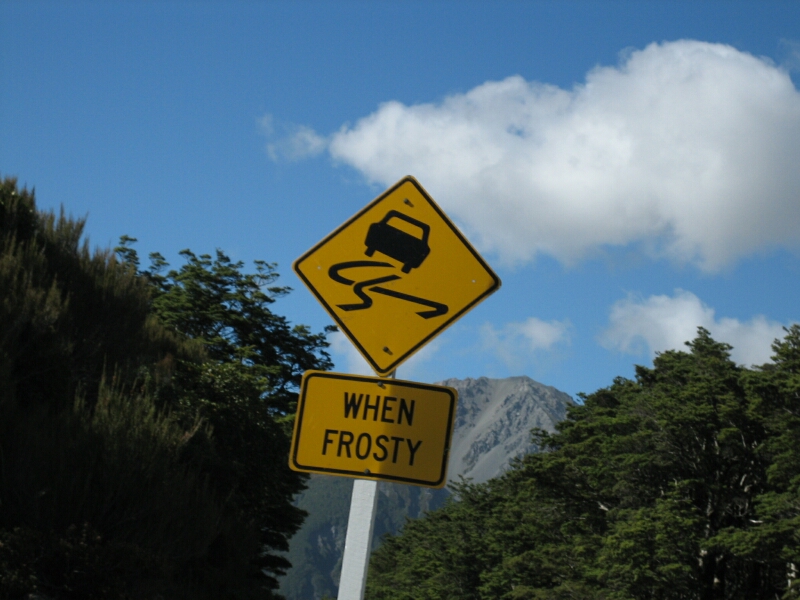
All over the island, except in Christchurch, two lane bridges are the exception, not the rule. Most of the time there is a little sign and paint to tell you which direction has the right of way, but I found determining who went first was mostly a game of chicken. One of my favorite bridges is this trestle bridge that also carries train tracks. (Note this bridge has a signal – the only bridge I ran across with one.) As you go across the bridge you can see the tracks above. Looking up the ties are visible. Crazy. My favorite bridge, near Greymouth, had the tracks on the same level as the cars. The signs indicating that the train tracks were ahead really are evocative. Note the background sign. That’s a guy falling off his bike as he hits the railroad tracks imbedded in the bridge ahead. However, my favorite sign was a reminder that the road could get slippery when “frosty.” Note that the skid marks cross on this sign. Rough place.
New Zealanders are an incredibly friendly and gregarious lot. I never had difficulty with asking questions about something or otherwise getting help or advice. But let me caution you that directions given by a New Zealander are often next to useless. For example, to find a certain store, I was told to “follow the main street until you get to the bank. It should be right there.” Which main street? “The one up there.” (We were on one main street, and there are several in a city.) Which bank? There is more than one!
I have changed my mind about the effectiveness of tipping in the States. There is no tipping in New Zealand, and service at restaurants is nearly nonexistent.
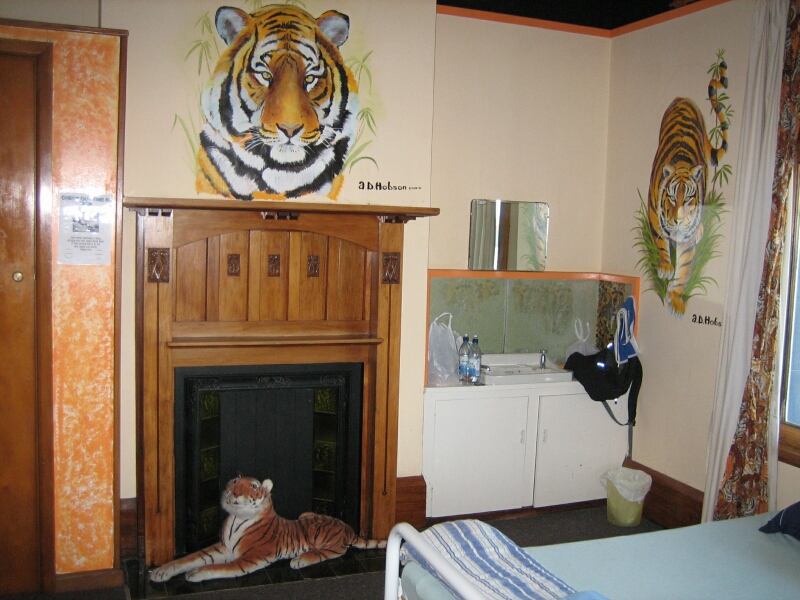
In towns, finding accommodations and food were not a problem. There are different levels, and a list from most primitive to most luxurious is youth hostel, backpackers, motel, B&B, and hotel. Plenty of choices. In Greymouth I stayed in a Noah’s Ark themed backpacker’s in the tiger room.
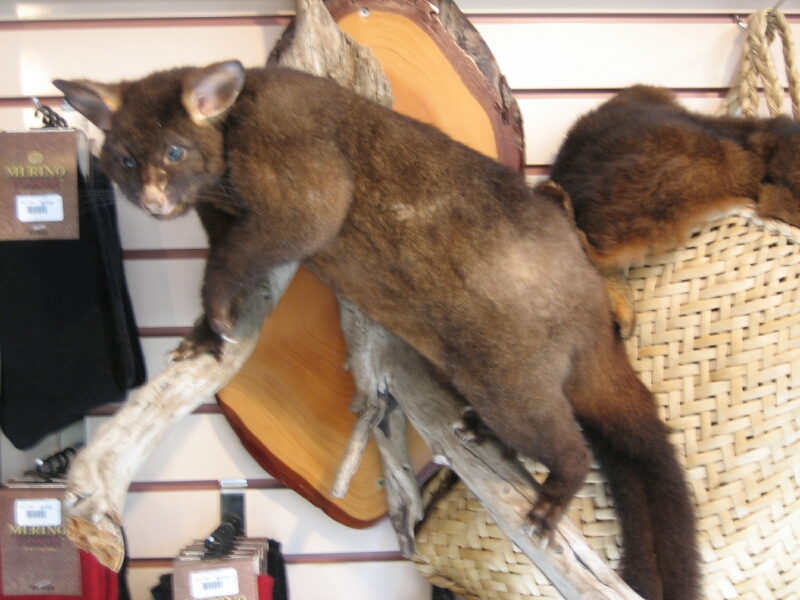
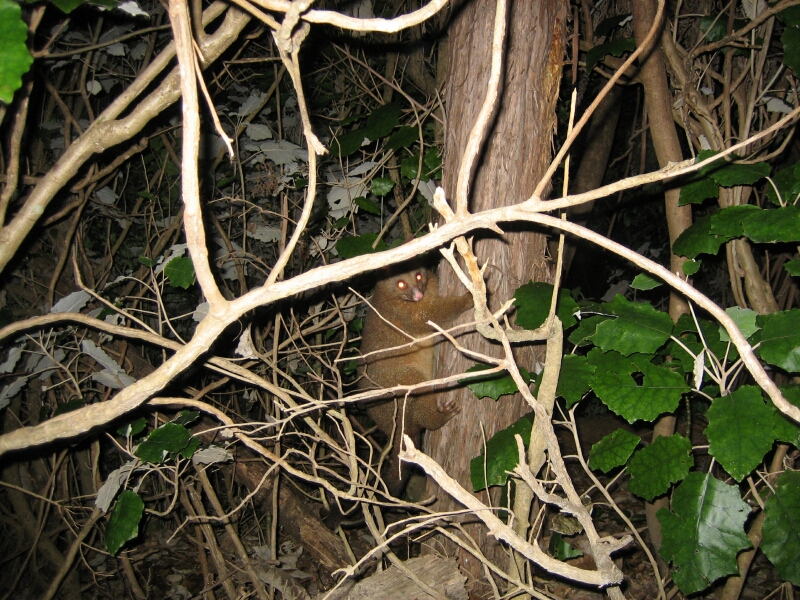
A final note of caution: The New Zealand possum is considered a pest, and its fur is used to make a variety of items, such as socks, gloves and hats. (Sorry the picture of this stuffed possum is a little out of focus.) This misuse makes them really mad, and at night you must be careful not to get attacked by killer possums coming out of the trees. I barely escaped this encounter with my life.
There are so many things to tell before launching into the travelogue, but I’ll just mention one more thing. I saw the Large and Small Magellanic Clouds, which are satellite galaxies of the Milky Way, as well as the infamous Southern Cross constellation. All of these are only visible from the southern hemisphere. Seeing these has been a lifelong desire of mine. BTW – Did you know that the moon looks upside down from the southern hemisphere?
You can follow along on the trip by going to some web sites with New Zealand maps, such as http://www.aatravel.co.nz/map/search-bymap.shtml?locationId=1. Click on the region of interest. I’ll give names.
I had found a friend to share a rental car with, and on the first day in Christchurch we made all our plans and reservations. Since New Zealanders use the Christmas holidays as their primary summer vacation, I was concerned that no housing would be available. But in the end there were no problems, since NZ’s don’t start their fun until after Christmas, and our trip would start Christmas Eve.
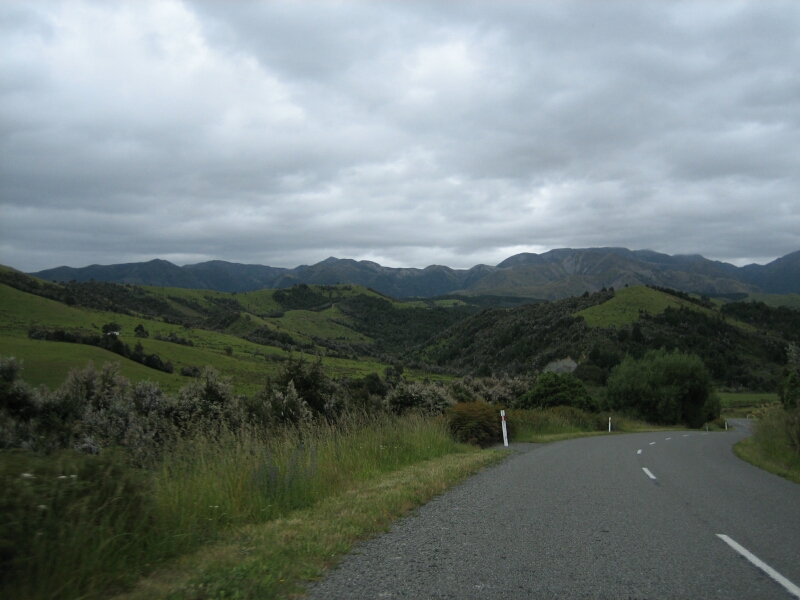
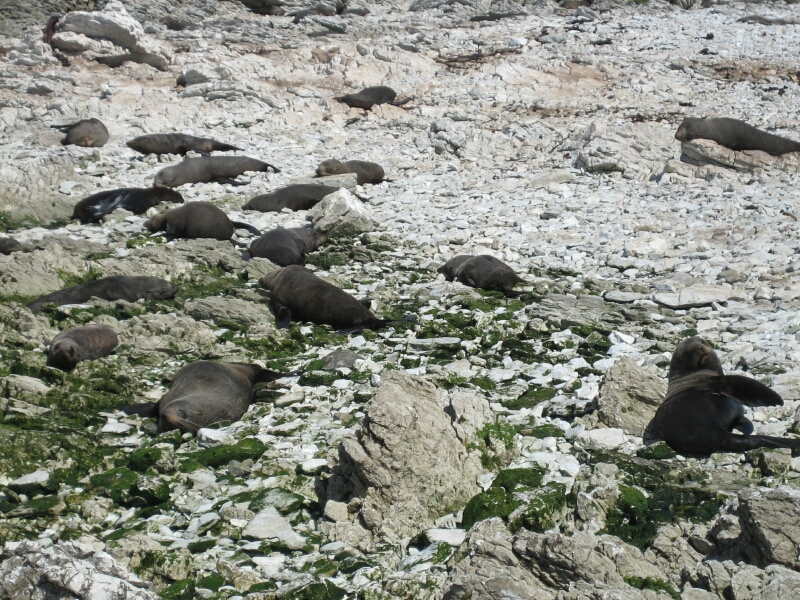
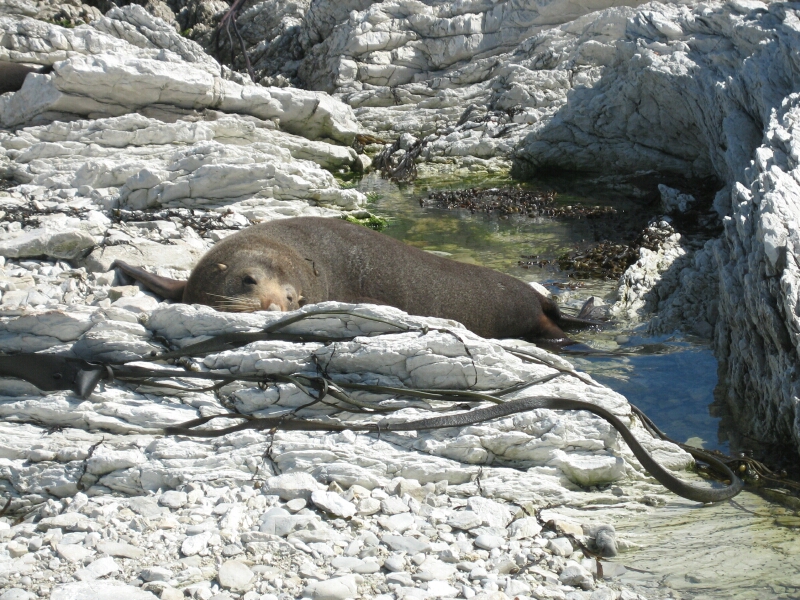
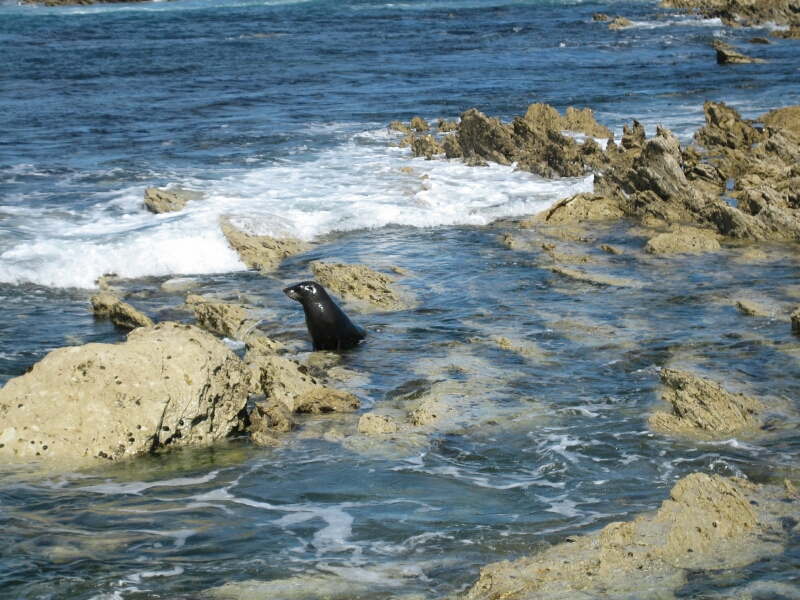
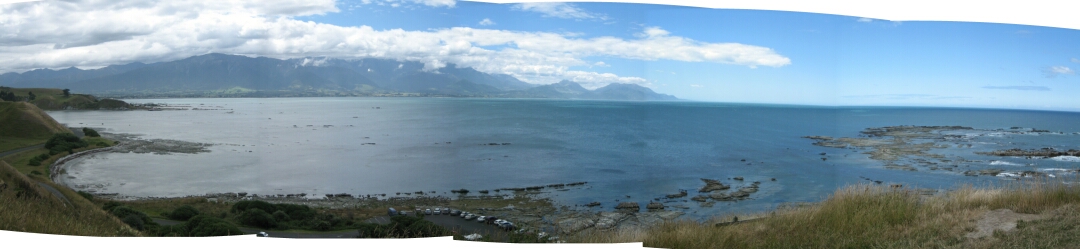
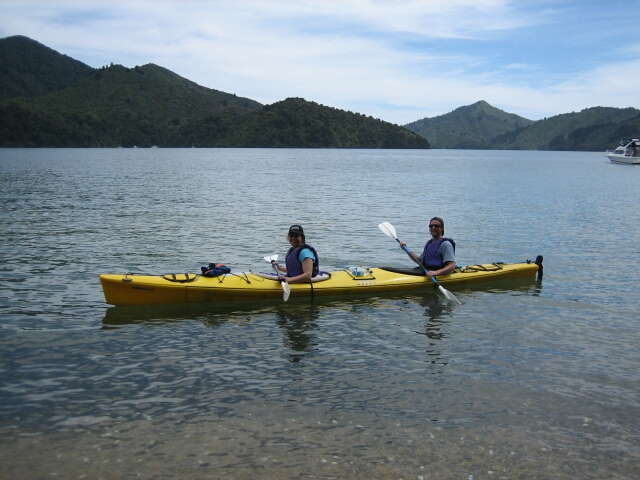
Here’s where you can start following the map: Starting in Christchurch, we took highway 1 up the coast towards Kaikoura, cutting in on a loop that took us to see more of the inner part of the island. The land is very mountainous, and sticking the camera out the window and snapping pictures gave us shots like this one. Kaikoura is a small town that advertises itself to be a starting place for a lot of water entertainment, such as swimming with dolphins or watching whales, but what I found was the seal colony. They look like so many giant slugs, except when they get in the water. The mountains touch the sea around the bay in Kaikoura, so the setting was quite beautiful. From there, we traveled to Picton, a small town in the Marlborough region at the north end of the South Island. In Picton, there were hiking trails through the forest, and we did some sea kayaking. The water was clear enough to see sting rays scoot across the bottom. Several species of cormorants, which they call shags, were very common.
From Picton we drove west on 63 to the west coast region, and stopped at Punakaiki. There are very nice stone formations which form blowholes as the waves come in. Unfortunately I had forgotten to charge my camera, so that part of the trip will forever be lost to photography. We stopped in Greymouth for the night, where I stayed in the backpackers mentioned above, and moved on across the north end of the Southern Alps in the morning through Arthur’s Pass, taking 73 back into the Christchurch/Canterbury region.
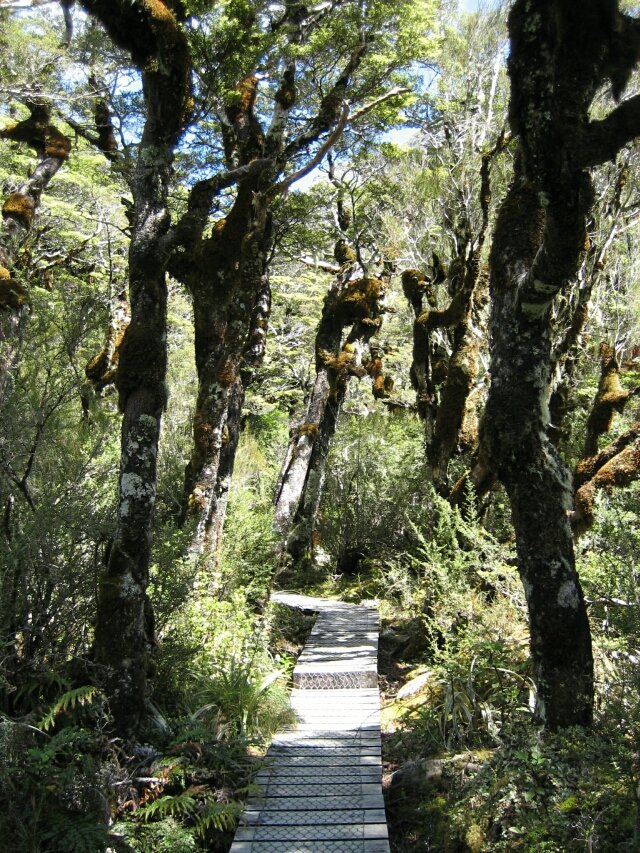
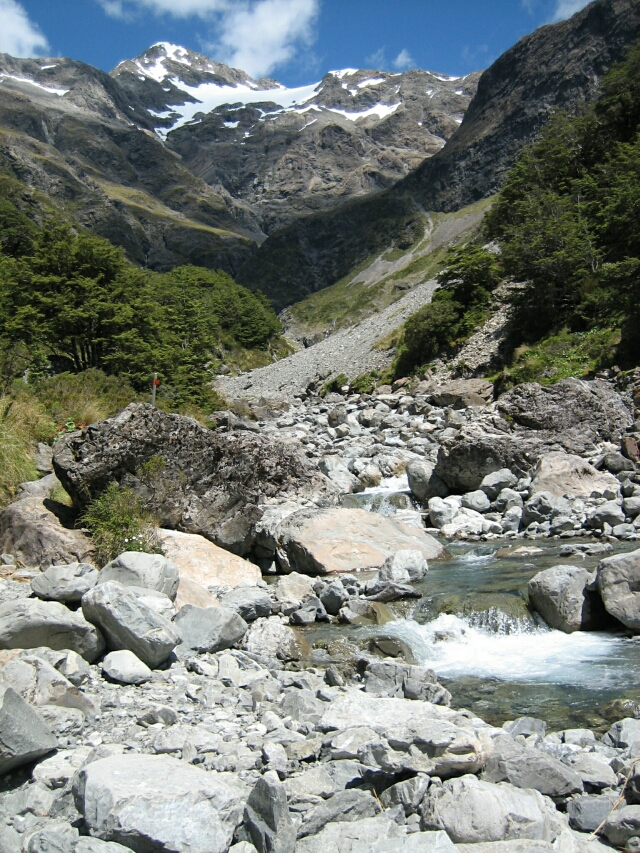
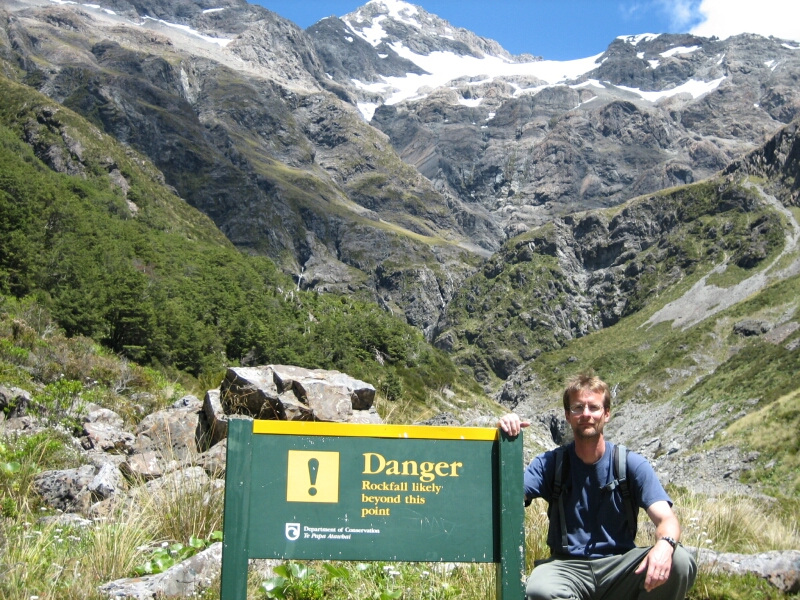
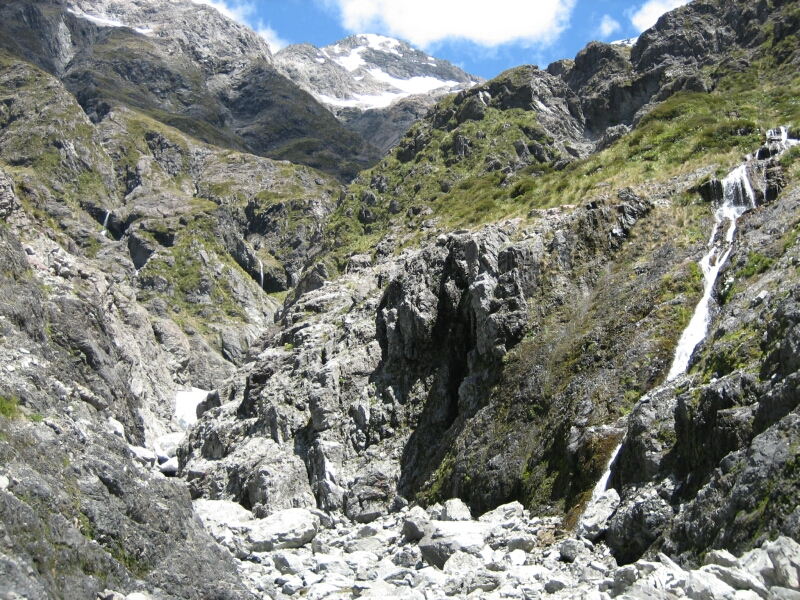
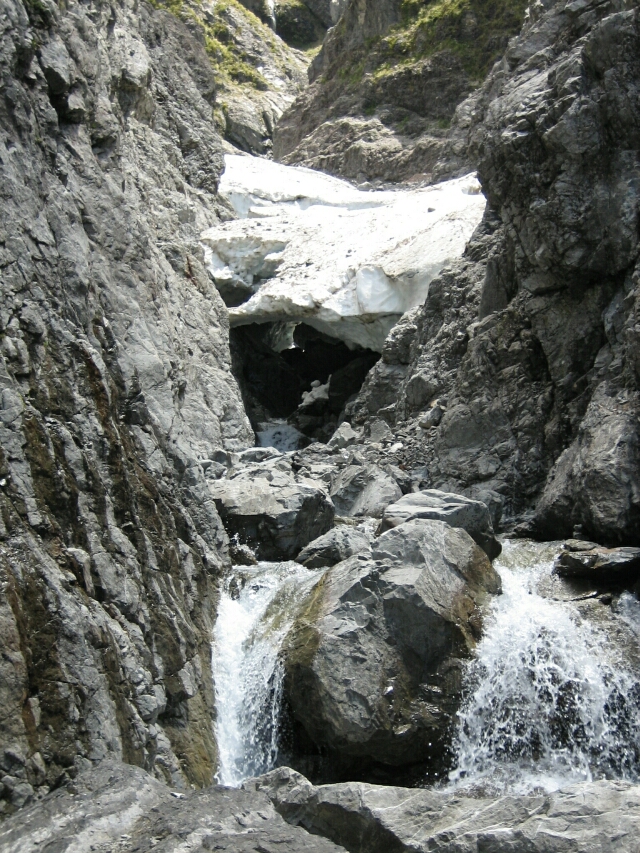
In Arthur’s Pass we took this incredible hike. It started off with nice boardwalk through beech forests, and after a while put us in a river bed. If you look carefully at this picture you can find the small orange trail marker up on the left side of the river bed. From here on out it was a mad scramble, past signs which did not deter me, up to a waterfall and false glacier, which was unmelted snow that the river had undercut. Lovely day. I got a pretty good sunburn during my after-lunch nap.
Pictures don’t do this justice. What made the trip so nice were the constant surprises. I ran into one nice place after another. I really MUST go back someday.
Before I get into the details of my NZ trip, I though I should give a few travel tips for the next time you go down there. First of all, if you get a car, be prepared to drive on the left side of the road. (My mantra for right turns was “Go right, stay left.”) Car travel times are much longer for a particular distance than you would expect in the States. There are no four lane roads (at least where I was), and although there is no traffic to speak of even during this busy holiday period, the roads are quite twisty and turny so travel is slow. Similarly, on the trails, signs posted to help the hiker time his day give times for walks that are ridiculously short. I am no slacker, but I would have had to practically jog to match the suggested times!
All over the island, except in Christchurch, two lane bridges are the exception, not the rule. Most of the time there is a little sign and paint to tell you which direction has the right of way, but I found determining who went first was mostly a game of chicken. One of my favorite bridges is this trestle bridge that also carries train tracks. (Note this bridge has a signal – the only bridge I ran across with one.) As you go across the bridge you can see the tracks above. Looking up the ties are visible. Crazy. My favorite bridge, near Greymouth, had the tracks on the same level as the cars. The signs indicating that the train tracks were ahead really are evocative. Note the background sign. That’s a guy falling off his bike as he hits the railroad tracks imbedded in the bridge ahead. However, my favorite sign was a reminder that the road could get slippery when “frosty.” Note that the skid marks cross on this sign. Rough place.
New Zealanders are an incredibly friendly and gregarious lot. I never had difficulty with asking questions about something or otherwise getting help or advice. But let me caution you that directions given by a New Zealander are often next to useless. For example, to find a certain store, I was told to “follow the main street until you get to the bank. It should be right there.” Which main street? “The one up there.” (We were on one main street, and there are several in a city.) Which bank? There is more than one!
I have changed my mind about the effectiveness of tipping in the States. There is no tipping in New Zealand, and service at restaurants is nearly nonexistent.
In towns, finding accommodations and food were not a problem. There are different levels, and a list from most primitive to most luxurious is youth hostel, backpackers, motel, B&B, and hotel. Plenty of choices. In Greymouth I stayed in a Noah’s Ark themed backpacker’s in the tiger room.
A final note of caution: The New Zealand possum is considered a pest, and its fur is used to make a variety of items, such as socks, gloves and hats. (Sorry the picture of this stuffed possum is a little out of focus.) This misuse makes them really mad, and at night you must be careful not to get attacked by killer possums coming out of the trees. I barely escaped this encounter with my life.
There are so many things to tell before launching into the travelogue, but I’ll just mention one more thing. I saw the Large and Small Magellanic Clouds, which are satellite galaxies of the Milky Way, as well as the infamous Southern Cross constellation. All of these are only visible from the southern hemisphere. Seeing these has been a lifelong desire of mine. BTW – Did you know that the moon looks upside down from the southern hemisphere?
You can follow along on the trip by going to some web sites with New Zealand maps, such as http://www.aatravel.co.nz/map/search-bymap.shtml?locationId=1. Click on the region of interest. I’ll give names.
I had found a friend to share a rental car with, and on the first day in Christchurch we made all our plans and reservations. Since New Zealanders use the Christmas holidays as their primary summer vacation, I was concerned that no housing would be available. But in the end there were no problems, since NZ’s don’t start their fun until after Christmas, and our trip would start Christmas Eve.
Here’s where you can start following the map: Starting in Christchurch, we took highway 1 up the coast towards Kaikoura, cutting in on a loop that took us to see more of the inner part of the island. The land is very mountainous, and sticking the camera out the window and snapping pictures gave us shots like this one. Kaikoura is a small town that advertises itself to be a starting place for a lot of water entertainment, such as swimming with dolphins or watching whales, but what I found was the seal colony. They look like so many giant slugs, except when they get in the water. The mountains touch the sea around the bay in Kaikoura, so the setting was quite beautiful. From there, we traveled to Picton, a small town in the Marlborough region at the north end of the South Island. In Picton, there were hiking trails through the forest, and we did some sea kayaking. The water was clear enough to see sting rays scoot across the bottom. Several species of cormorants, which they call shags, were very common.
From Picton we drove west on 63 to the west coast region, and stopped at Punakaiki. There are very nice stone formations which form blowholes as the waves come in. Unfortunately I had forgotten to charge my camera, so that part of the trip will forever be lost to photography. We stopped in Greymouth for the night, where I stayed in the backpackers mentioned above, and moved on across the north end of the Southern Alps in the morning through Arthur’s Pass, taking 73 back into the Christchurch/Canterbury region.
In Arthur’s Pass we took this incredible hike. It started off with nice boardwalk through beech forests, and after a while put us in a river bed. If you look carefully at this picture you can find the small orange trail marker up on the left side of the river bed. From here on out it was a mad scramble, past signs which did not deter me, up to a waterfall and false glacier, which was unmelted snow that the river had undercut. Lovely day. I got a pretty good sunburn during my after-lunch nap.
Pictures don’t do this justice. What made the trip so nice were the constant surprises. I ran into one nice place after another. I really MUST go back someday.
Sunday, January 01, 2006
Leaving McMurdo
Well, I’m back in the US. I arrived just before midnight on Thursday, Dec 29, a day that started the previous midnight 42 hours before. I was up for a good many of those hours. Overall the trip was a great success. Our instrument, CREAM, is still up in the air as of this writing (New Year’s Day). You can follow its position at http://www.wff.nasa.gov/BPO/creamweb/edrs/viewimage.php?image=GPS_fig11.jpg
(It was the other science group, ATIC, that had the bad balloon.)
I wanted to share with you my last few adventures, including flying out of McMurdo in a C17 cargo jet and exploring New Zealand. First, in this installment, the trip out of McMurdo:
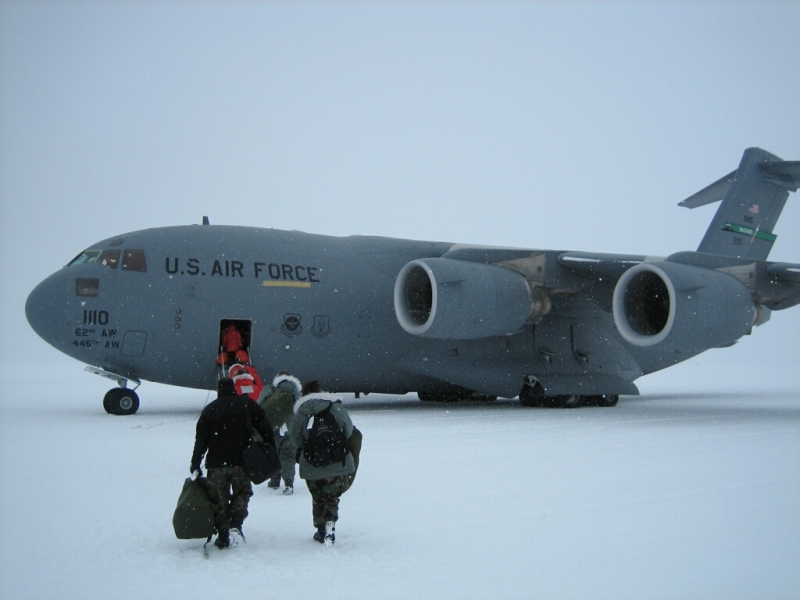
I was supposed to leave on Dec 21, but, as I mentioned previously, the flight was cancelled that day and moved to the 22nd. The plane for the return trip is very different than the one I took down. Recall that the flight down was on a C130 propeller-driven cargo plane (shown earlier) and took seven hours in cramped conditions. However, the C130 planes landed conveniently just outside McMurdo on the Ice Runway. Sadly, the ice that it landed on melts in the summer, and it is too late in the season now to use it, so a runway on the permanent ice shelf, about 10 miles out from McMurdo, called Pegasus, was used for the return trip. That runway can have C17 Globemaster jets land on it. These jets can fly down from Christchurch and return in one day. The trip is only about 4 hours, and the planes are newer, so more mechanically reliable. (Several times C130 flights were cancelled due to mechanical difficulties.)
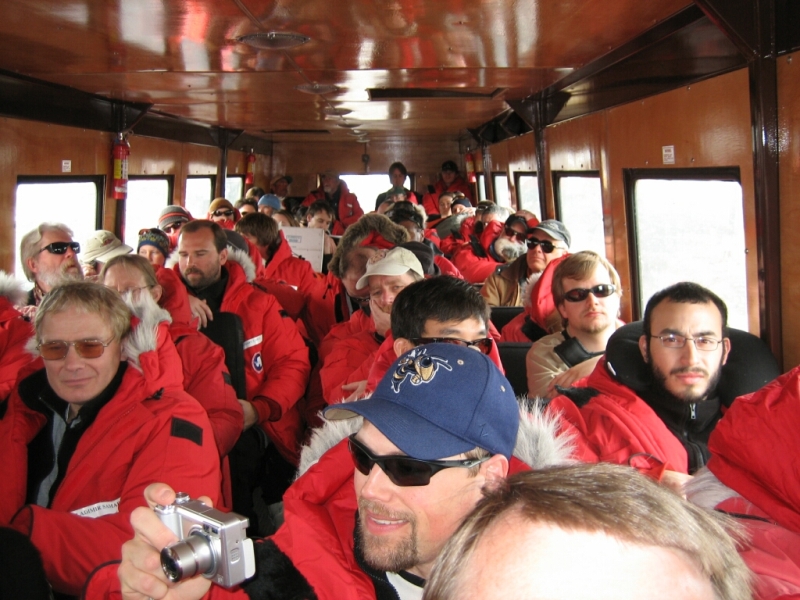
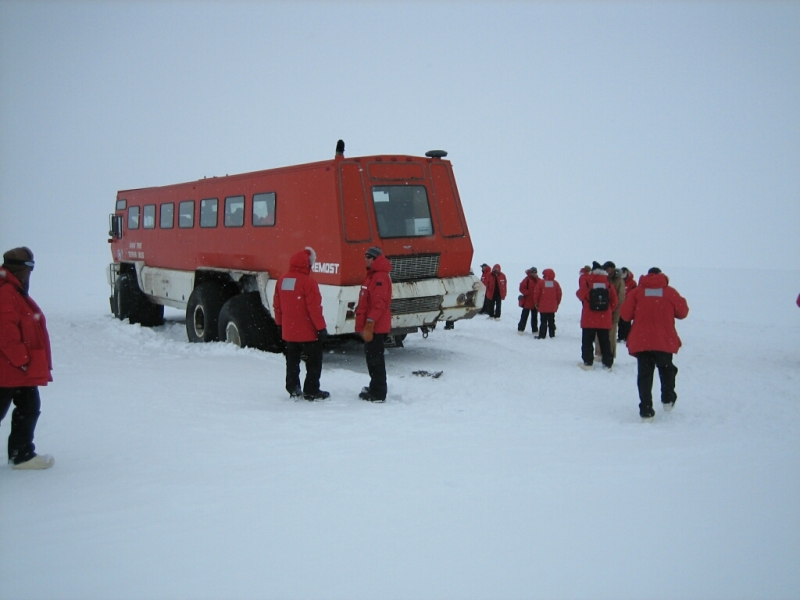
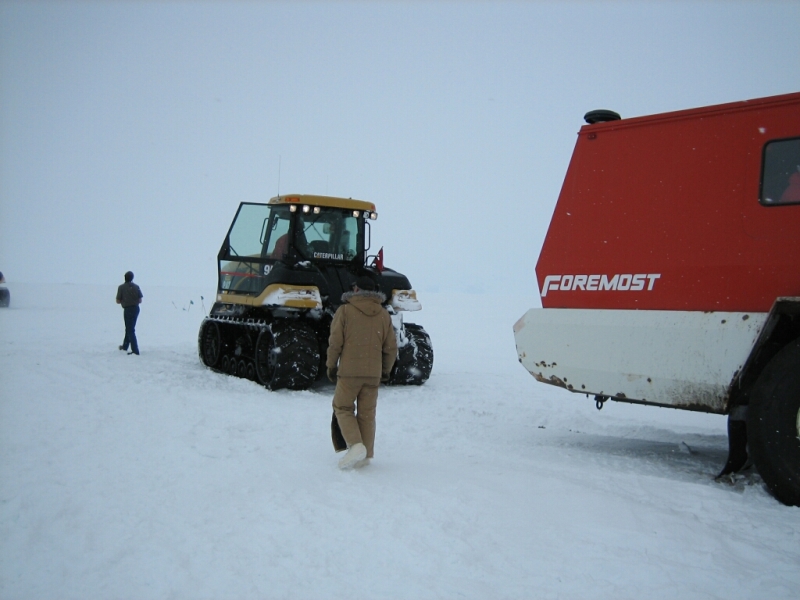
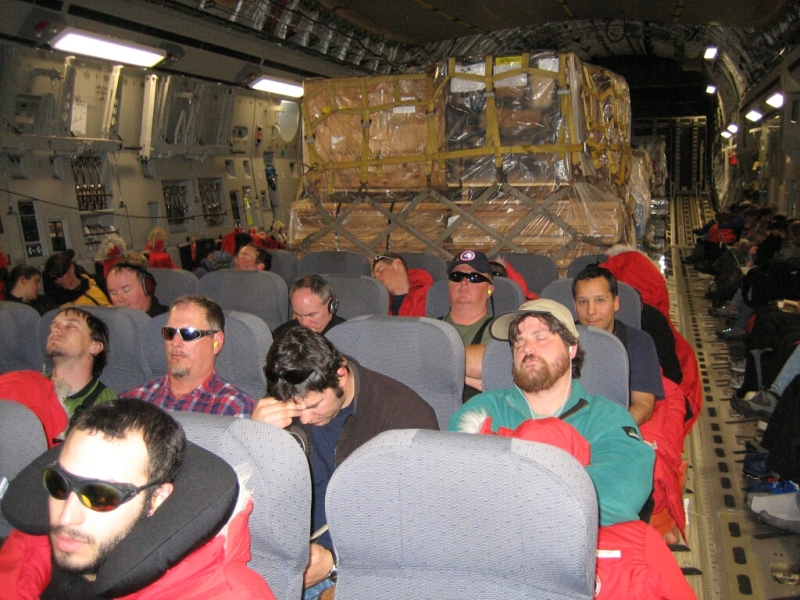
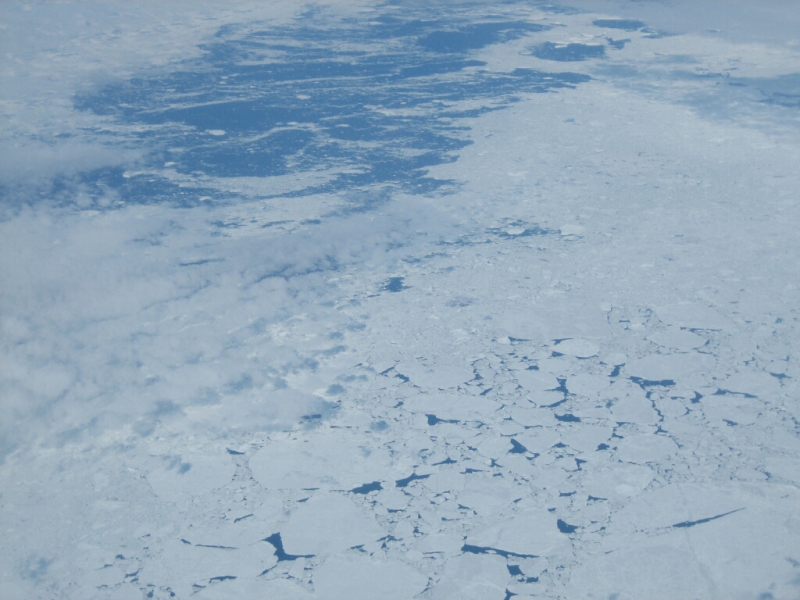
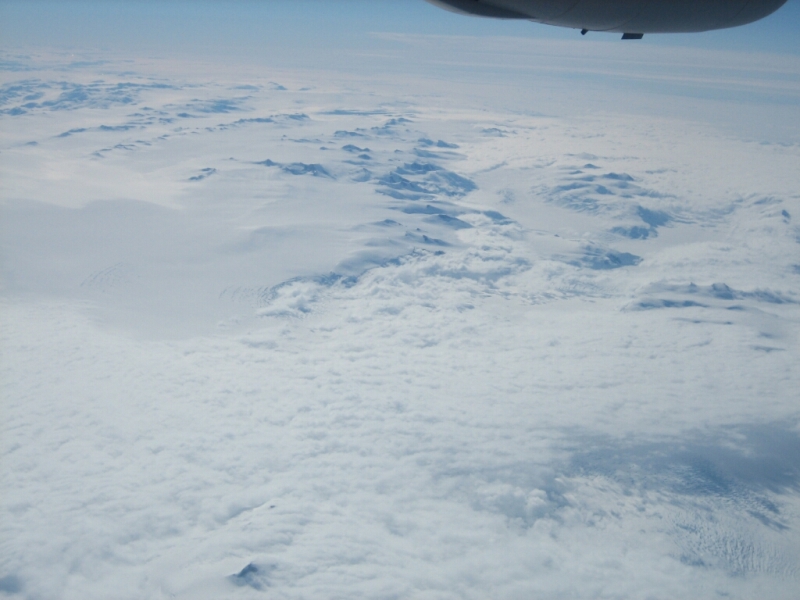
On the day we were to depart the weather was poor. It was snowing hard, but at least the wind was not very strong. The journey out to the runway was in Ivan the Terrabus. Finally, I got to ride it! However, poor old Ivan got stuck in blowing snow, despite its huge tires. We had to be rescued by two caterpillar tractors, which then accompanied us the rest of the way out to the runway. After a long wait we boarded the plane. What relative luxury! The interior was much roomier. There were even some REAL SEATS! Even one real bathroom this time, as opposed to the wall mounted receptacles in the C130. While many people slept, I took pictures of sea ice and continental ice below. In this last photo you can see the wing of the plane above, and some crevasses in the lower right. There is also fog or windblown snow over a large region of the lower right as well. Mountains stick up above the ice. My last sight of Antarctica.
Four hours after takeoff, at about 10 PM, I was in Christchurch. Civilization! And darkness!! When the airplane door was opened it was dark out. All of us were quite surprised, since we were used to the constant light of Antarctic summer. It was rather surreal for a while. After all, McMurdo is at about 78 degrees south latitude – only 12 degrees from the Pole, and well within the Antarctic Circle.
I was ready for the next part of my adventure, which was to explore as much of New Zealand as I could in 5 days.
(It was the other science group, ATIC, that had the bad balloon.)
I wanted to share with you my last few adventures, including flying out of McMurdo in a C17 cargo jet and exploring New Zealand. First, in this installment, the trip out of McMurdo:
I was supposed to leave on Dec 21, but, as I mentioned previously, the flight was cancelled that day and moved to the 22nd. The plane for the return trip is very different than the one I took down. Recall that the flight down was on a C130 propeller-driven cargo plane (shown earlier) and took seven hours in cramped conditions. However, the C130 planes landed conveniently just outside McMurdo on the Ice Runway. Sadly, the ice that it landed on melts in the summer, and it is too late in the season now to use it, so a runway on the permanent ice shelf, about 10 miles out from McMurdo, called Pegasus, was used for the return trip. That runway can have C17 Globemaster jets land on it. These jets can fly down from Christchurch and return in one day. The trip is only about 4 hours, and the planes are newer, so more mechanically reliable. (Several times C130 flights were cancelled due to mechanical difficulties.)
On the day we were to depart the weather was poor. It was snowing hard, but at least the wind was not very strong. The journey out to the runway was in Ivan the Terrabus. Finally, I got to ride it! However, poor old Ivan got stuck in blowing snow, despite its huge tires. We had to be rescued by two caterpillar tractors, which then accompanied us the rest of the way out to the runway. After a long wait we boarded the plane. What relative luxury! The interior was much roomier. There were even some REAL SEATS! Even one real bathroom this time, as opposed to the wall mounted receptacles in the C130. While many people slept, I took pictures of sea ice and continental ice below. In this last photo you can see the wing of the plane above, and some crevasses in the lower right. There is also fog or windblown snow over a large region of the lower right as well. Mountains stick up above the ice. My last sight of Antarctica.
Four hours after takeoff, at about 10 PM, I was in Christchurch. Civilization! And darkness!! When the airplane door was opened it was dark out. All of us were quite surprised, since we were used to the constant light of Antarctic summer. It was rather surreal for a while. After all, McMurdo is at about 78 degrees south latitude – only 12 degrees from the Pole, and well within the Antarctic Circle.
I was ready for the next part of my adventure, which was to explore as much of New Zealand as I could in 5 days.
Tuesday, December 20, 2005
Food and more (or less)
I never went back to talk about food. I can say that at least it is plentiful, if not particularly delicious. Fresh veggies and fruit are a real delicacy, and are rarely available. People were really excited when we got fresh lettuce for a salad the other night. McMurdites call fresh veggies and fruits “freshies.”
Personally, of the three meals a day (not including “mid-rats,” for the night shift), I like the breakfasts most. Sausage, eggs, made to order omelets…. Wednesday morning is waffle day (my favorite), and Sunday (everyone’s day off) has a big brunch from 10-noon. The dining hall is the main place to eat, but some of the more remote sites (various airfields) in the area have their own galleys. Most of the time this just means a truck is loaded up with trays from the main dining hall and carted out. That food is cold and even more stale than usual by the time workers get to eat it. The balloon area, however, has its own cook and galley. This is needed because of the wild hours ballooners keep. (The weather never cooperates fully.)
 The galley may not look like much, but it holds a secret. John the cook is a great find. He is very accommodating, and his food tastes really good. He brings his own spices, and only cooks for 20-70 people at a time, so can concentrate on quality over quantity. Sadly, he only provides lunch, unless a launch makes us keep other hours. After our launch, at 9AM, he made me eggs and bacon. A really good fellow. I am always looking for an excuse to spend lunch out at the hangar.
Time’s up! But tune in next week….
I was scheduled to leave this morning, Wednesday, Dec 21, for Christchurch, but the plane is delayed until tomorrow due to weather. Very typical. And tomorrow it may be delayed again. My colleague was delayed for six days during a bad spate of weather and mechanical trouble with the Kiwi C130s. Don’t ever make carefully timed plans when you are in Antarctica. From Christchurch I will take a week or so exploring the south island of New Zealand. I doubt I will be able to file blogs during that time, but I promise to post pictures and news when I return. So around the New Year, spend some time perusing this blog yet again.
I have fixed the problems with the photo links. Drop me a comment (as anonymous if you do not have an account, or just sign up for one – free!) if you continue to have problems.
Personally, of the three meals a day (not including “mid-rats,” for the night shift), I like the breakfasts most. Sausage, eggs, made to order omelets…. Wednesday morning is waffle day (my favorite), and Sunday (everyone’s day off) has a big brunch from 10-noon. The dining hall is the main place to eat, but some of the more remote sites (various airfields) in the area have their own galleys. Most of the time this just means a truck is loaded up with trays from the main dining hall and carted out. That food is cold and even more stale than usual by the time workers get to eat it. The balloon area, however, has its own cook and galley. This is needed because of the wild hours ballooners keep. (The weather never cooperates fully.)
 The galley may not look like much, but it holds a secret. John the cook is a great find. He is very accommodating, and his food tastes really good. He brings his own spices, and only cooks for 20-70 people at a time, so can concentrate on quality over quantity. Sadly, he only provides lunch, unless a launch makes us keep other hours. After our launch, at 9AM, he made me eggs and bacon. A really good fellow. I am always looking for an excuse to spend lunch out at the hangar.
Time’s up! But tune in next week….
I was scheduled to leave this morning, Wednesday, Dec 21, for Christchurch, but the plane is delayed until tomorrow due to weather. Very typical. And tomorrow it may be delayed again. My colleague was delayed for six days during a bad spate of weather and mechanical trouble with the Kiwi C130s. Don’t ever make carefully timed plans when you are in Antarctica. From Christchurch I will take a week or so exploring the south island of New Zealand. I doubt I will be able to file blogs during that time, but I promise to post pictures and news when I return. So around the New Year, spend some time perusing this blog yet again.
I have fixed the problems with the photo links. Drop me a comment (as anonymous if you do not have an account, or just sign up for one – free!) if you continue to have problems.
Monday, December 19, 2005
Castle Rock
While I was waiting for my flight to depart, I hiked a 7 mile loop from McMurdo to Castle Rock, a prominent volcanic feature on a promontory. There are several trails (trail map) around McMurdo, and a few of them require you to check out at the Firehouse before leaving. If you are not back at the time you say, there is a full alert out and a search party is sent out after you. Weather turns in an instant, and dangers lurk around the ice. I carried a radio in case of trouble, and along the trail there are huts with food and sleeping bags for hikers caught in bad weather. These are called apple huts. If you see the picture the reason is obvious. The landscape is fantastic, but even the small scale is interesting. Here is a close up picture of wind carved snow in an area no bigger than my hand.
You have to wear serious gear in case of trouble, and I wore the infamous “bunny boots.” These keep your feet very warm, but had given me a blister by the time I reached Castle Rock. Here I am tending my injury in front of CR. Right next to me was this exposed rock indicative of the rock and soil in the area. The origin is obviously volcanic. And of course the volcano is nearby: Mt. Erebus towers over everything as we began our climb to the top of Castle Rock. The hike to the top of CR was kind of treacherous. There was a lot of climbing. Ropes were laid out to help you as you ascended. Finally, we reached the top of CR (note the bunny boots that gave me blisters).
At the bottom, my hiking partner, Young Soo Yoon (a colleague on CREAM-II), and I posed for a self-taken photo in front of the rock. The trip back was all downhill, and we came prepared. We each had trays borrowed from the dining hall, and we were ready to use them. The hill felt like it was straight down, so we could get going pretty fast.
But we had to stick to the trail. Crevices in the ice, formed as the ice slides down the hill, can be very dangerous. Black flags mark danger areas. Note that you can’t tell that there is a crack there. Blown snow covers the top, making a thin crust that crumples when you walk on it. There are many terrible stories of people who have died stuck in a crevice, including a few who went off the trails around McMurdo in the last few decades.
There is a funny story connecting these and the trays. Young Soo slipped off his tray as he was sliding and the tray kept going until it stopped right on top of the crevice with these flags. He wanted to go get it but I convinced him it would be unwise. He felt bad because we try so hard to Keep Antarctica Beautiful. When we got back to the Firehouse to check we confessed that while all the people had made it back, not all our objects made it back. Immediately the dispatcher said “Let me guess – what you are missing is rectangular, flat, and blue.” Yup. Apparently this was not even close to the first time. The dispatcher confessed that she lost her own tray once.
The rest of the journey was along where the Ross Ice Shelf meets Ross Island. There were ice formations and pressure ridges. The total time we were gone was about 5 hours.
You have to wear serious gear in case of trouble, and I wore the infamous “bunny boots.” These keep your feet very warm, but had given me a blister by the time I reached Castle Rock. Here I am tending my injury in front of CR. Right next to me was this exposed rock indicative of the rock and soil in the area. The origin is obviously volcanic. And of course the volcano is nearby: Mt. Erebus towers over everything as we began our climb to the top of Castle Rock. The hike to the top of CR was kind of treacherous. There was a lot of climbing. Ropes were laid out to help you as you ascended. Finally, we reached the top of CR (note the bunny boots that gave me blisters).
At the bottom, my hiking partner, Young Soo Yoon (a colleague on CREAM-II), and I posed for a self-taken photo in front of the rock. The trip back was all downhill, and we came prepared. We each had trays borrowed from the dining hall, and we were ready to use them. The hill felt like it was straight down, so we could get going pretty fast.
But we had to stick to the trail. Crevices in the ice, formed as the ice slides down the hill, can be very dangerous. Black flags mark danger areas. Note that you can’t tell that there is a crack there. Blown snow covers the top, making a thin crust that crumples when you walk on it. There are many terrible stories of people who have died stuck in a crevice, including a few who went off the trails around McMurdo in the last few decades.
There is a funny story connecting these and the trays. Young Soo slipped off his tray as he was sliding and the tray kept going until it stopped right on top of the crevice with these flags. He wanted to go get it but I convinced him it would be unwise. He felt bad because we try so hard to Keep Antarctica Beautiful. When we got back to the Firehouse to check we confessed that while all the people had made it back, not all our objects made it back. Immediately the dispatcher said “Let me guess – what you are missing is rectangular, flat, and blue.” Yup. Apparently this was not even close to the first time. The dispatcher confessed that she lost her own tray once.
The rest of the journey was along where the Ross Ice Shelf meets Ross Island. There were ice formations and pressure ridges. The total time we were gone was about 5 hours.
Ballooning gone bad
Sometimes things just don’t go your way. The second payload was launched yesterday, but the balloon failed. Everyone is disappointed when this happens, whether to them or a colleague. The more times these launches are successful, the more likely they will continue to be funded.
A high altitude balloon is a very complicated device. You saw in a previous post how a launch is supposed to look. Here is a post of how it is not supposed to look.
The ATTIC instrument was taken to the launch pad ahead of schedule. The launch window, defined by low, steady winds reaching more than 1000 feet high, was moving forward in time. NSBF worked hard and had the balloon laid out and ready to go. Launch occurred, but at a few hundred feet altitude some cross winds came in and twisted the balloon. A collar that keeps the balloon from opening before float was released, and the balloon started opening up more than it should have. Compare this to the CREAM photos from earlier. Remember that most of the unopened section you see above the parachute and below the bulb (the portion of the balloon that looks like a balloon) is balloon waiting to open. When all the fabric was exposed it acted like a sail.
A high altitude balloon is a very complicated device. You saw in a previous post how a launch is supposed to look. Here is a post of how it is not supposed to look.
The ATTIC instrument was taken to the launch pad ahead of schedule. The launch window, defined by low, steady winds reaching more than 1000 feet high, was moving forward in time. NSBF worked hard and had the balloon laid out and ready to go. Launch occurred, but at a few hundred feet altitude some cross winds came in and twisted the balloon. A collar that keeps the balloon from opening before float was released, and the balloon started opening up more than it should have. Compare this to the CREAM photos from earlier. Remember that most of the unopened section you see above the parachute and below the bulb (the portion of the balloon that looks like a balloon) is balloon waiting to open. When all the fabric was exposed it acted like a sail.
The CREAM Instrument and Ballooning in Antarctica
Why do I bother spending a couple weeks in Antarctica? And why in Antarctica? The answers to these questions lie in the nature of the CREAM experiment. The CREAM (Cosmic Ray Energetics and Mass) instrument is designed to measure the relative abundance of elements in the cosmic rays at high energies.
What is a cosmic ray? The name makes them sound like something out of a science fiction movie. Really, though, the name makes sense in the historical context in which the name was born. “Cosmic” just means from outside the Earth, and “ray” is what early scientists called anything that was an energetic fundamental particle. Hence “cathode rays,” “delta rays,” “x-rays,” and “gamma rays.” We now understand that most cosmic rays are just the nuclei of atoms (atomic elements stripped of electrons) which were accelerated to near light speed in supernova shocks throughout our galaxy. The relative abundance of the elements in the cosmic rays reflects nearly the same abundances in the Solar System, with a few differences that are understood. By the way, the Universe is 90% hydrogen and 10% helium. Everything else is present in minute quantities. What we experience here on Earth, with high abundances of iron, nickel, silicon, oxygen, carbon, and other useful elements, is very different from the average spot in space.
What is remarkable about cosmic rays is that as interstellar travelers they give us an opportunity to look at the elemental composition of the rest of the galaxy. Of course, nothing is that easy, and working backwards from what we detect here at Earth to what was present in the interstellar medium when the supernova shock hit is quite challenging. A lot can happen to a cosmic ray between acceleration and detection. Most importantly, the cosmic ray can interact with atomic hydrogen gas and spallate, which means it can fragment into smaller pieces. Thus the cosmic ray elemental abundances have some elements which are relatively more abundant than Solar System values because the increased abundance was created between acceleration and detection at Earth.
The CREAM instrument is measuring the charge (hence identifying the element) and the energy (think of it as the velocity) of each through-going particle. An overview of the detector and how it works, as well as additional science information, can be found at http://cosmicray.umd.edu/cream. The region of energy that CREAM is exploring is interesting because it represents a change from galactic supernova as the source of acceleration to something else – we are not sure what. The shape of a plot of number of particles detected at a certain energy vs. energy is in agreement with predictions by the supernova remnant theory up until a certain energy. Then the plot changes shape. CREAM is trying to understand whether there is also a change in the relative abundance of what gets tossed into space by this new mechanism. If it is, say, heavier in iron (or conversely hydrogen) than the Solar System abundances (and low energy cosmic rays) that could tell us that the source material is different from just plain old interstellar medium, and could be something exotic like material around a black hole or neutron star.
Why Antarctica? Cosmic rays at the high energies where CREAM is looking are very rare. Only a few of the highest energy particles strike our detector every day, so we need to look for many days in order to collect enough of them to be sure of their relative abundances. The NASA balloon program is a cheaper alternative to satellites. The National Scientific Balloon Facility, operated out of Palestine, TX (small town near Dallas), offers large high altitude balloons to scientific collaborations as alternatives to satellite launches. The balloons float at 120,000 feet, above 99.5% of the mass of the atmosphere – essentially outer space. Remember that a jet flies at about 35,000 feet.
Remember “Better, faster, cheaper”? Well, ballooning is at least faster and cheaper, and in some ways better. A typical balloon payload can go from proposal to launch in less than five years, while a satellite instrument is often decades in the making. And the balloon can be launched for well under $1M, while a satellite is many hundreds of millions of dollars. The disadvantage is the amount of time a balloon is up in the air is much less than a satellite. This is where Antarctica comes in.
While a balloon can be launched from anywhere, it is important that it be done so over uninhabited areas, since its direction can not be controlled. The winds at 120,000 feet blow east-west or west-east, and switch directions twice a year. A balloon sent up during “turnaround,” which lasts about a week, will come down near where it was sent up. But a balloon launched at another time can cruise from 20 to 120 knots, and quickly moves the middle of nowhere to some inhabited area. It is very unpleasant to have a 5000 pound instrument crash into your living room. So launch sites include northern Canada, Ft. Sumner, NM, Sweden (for an Atlantic Ocean flyover), and Antarctica. Antarctica has the added advantage that the winds are circular, around the Pole (hence the ozone hole, since the air does not mix with the rest of the atmosphere during the Antarctic summer), so something sent up from McMurdo will return about 10 days later, and then 10 days after that, etc…. Float times are limited by the balloon technology more than safety concerns. Last year the CREAM instrument flew for 42 days, a record.
Want to follow CREAM as it goes around and around the Pole? Go to the tracking web site run by Wallops: http://www.wff.nasa.gov/BPO/creamweb/edrs/pos_alt.htm
Here are some pictures of the CREAM instrument this year:
It all started earlier this spring in my lab, fabricating the detector for which I am responsible.
After my part was integrated into the instrument, CREAM journeyed to Wallops Flight Facility near Chicoteague VA for communications systems testing.
The instrument in the hangar here at McMurdo, ready for launch. Note the NKU sticker.
You have already seen this picture of the instrument hanging from the crane, ready to roll out to the launch pad.
What is a cosmic ray? The name makes them sound like something out of a science fiction movie. Really, though, the name makes sense in the historical context in which the name was born. “Cosmic” just means from outside the Earth, and “ray” is what early scientists called anything that was an energetic fundamental particle. Hence “cathode rays,” “delta rays,” “x-rays,” and “gamma rays.” We now understand that most cosmic rays are just the nuclei of atoms (atomic elements stripped of electrons) which were accelerated to near light speed in supernova shocks throughout our galaxy. The relative abundance of the elements in the cosmic rays reflects nearly the same abundances in the Solar System, with a few differences that are understood. By the way, the Universe is 90% hydrogen and 10% helium. Everything else is present in minute quantities. What we experience here on Earth, with high abundances of iron, nickel, silicon, oxygen, carbon, and other useful elements, is very different from the average spot in space.
What is remarkable about cosmic rays is that as interstellar travelers they give us an opportunity to look at the elemental composition of the rest of the galaxy. Of course, nothing is that easy, and working backwards from what we detect here at Earth to what was present in the interstellar medium when the supernova shock hit is quite challenging. A lot can happen to a cosmic ray between acceleration and detection. Most importantly, the cosmic ray can interact with atomic hydrogen gas and spallate, which means it can fragment into smaller pieces. Thus the cosmic ray elemental abundances have some elements which are relatively more abundant than Solar System values because the increased abundance was created between acceleration and detection at Earth.
The CREAM instrument is measuring the charge (hence identifying the element) and the energy (think of it as the velocity) of each through-going particle. An overview of the detector and how it works, as well as additional science information, can be found at http://cosmicray.umd.edu/cream. The region of energy that CREAM is exploring is interesting because it represents a change from galactic supernova as the source of acceleration to something else – we are not sure what. The shape of a plot of number of particles detected at a certain energy vs. energy is in agreement with predictions by the supernova remnant theory up until a certain energy. Then the plot changes shape. CREAM is trying to understand whether there is also a change in the relative abundance of what gets tossed into space by this new mechanism. If it is, say, heavier in iron (or conversely hydrogen) than the Solar System abundances (and low energy cosmic rays) that could tell us that the source material is different from just plain old interstellar medium, and could be something exotic like material around a black hole or neutron star.
Why Antarctica? Cosmic rays at the high energies where CREAM is looking are very rare. Only a few of the highest energy particles strike our detector every day, so we need to look for many days in order to collect enough of them to be sure of their relative abundances. The NASA balloon program is a cheaper alternative to satellites. The National Scientific Balloon Facility, operated out of Palestine, TX (small town near Dallas), offers large high altitude balloons to scientific collaborations as alternatives to satellite launches. The balloons float at 120,000 feet, above 99.5% of the mass of the atmosphere – essentially outer space. Remember that a jet flies at about 35,000 feet.
Remember “Better, faster, cheaper”? Well, ballooning is at least faster and cheaper, and in some ways better. A typical balloon payload can go from proposal to launch in less than five years, while a satellite instrument is often decades in the making. And the balloon can be launched for well under $1M, while a satellite is many hundreds of millions of dollars. The disadvantage is the amount of time a balloon is up in the air is much less than a satellite. This is where Antarctica comes in.
While a balloon can be launched from anywhere, it is important that it be done so over uninhabited areas, since its direction can not be controlled. The winds at 120,000 feet blow east-west or west-east, and switch directions twice a year. A balloon sent up during “turnaround,” which lasts about a week, will come down near where it was sent up. But a balloon launched at another time can cruise from 20 to 120 knots, and quickly moves the middle of nowhere to some inhabited area. It is very unpleasant to have a 5000 pound instrument crash into your living room. So launch sites include northern Canada, Ft. Sumner, NM, Sweden (for an Atlantic Ocean flyover), and Antarctica. Antarctica has the added advantage that the winds are circular, around the Pole (hence the ozone hole, since the air does not mix with the rest of the atmosphere during the Antarctic summer), so something sent up from McMurdo will return about 10 days later, and then 10 days after that, etc…. Float times are limited by the balloon technology more than safety concerns. Last year the CREAM instrument flew for 42 days, a record.
Want to follow CREAM as it goes around and around the Pole? Go to the tracking web site run by Wallops: http://www.wff.nasa.gov/BPO/creamweb/edrs/pos_alt.htm
Here are some pictures of the CREAM instrument this year:
It all started earlier this spring in my lab, fabricating the detector for which I am responsible.
After my part was integrated into the instrument, CREAM journeyed to Wallops Flight Facility near Chicoteague VA for communications systems testing.
The instrument in the hangar here at McMurdo, ready for launch. Note the NKU sticker.
You have already seen this picture of the instrument hanging from the crane, ready to roll out to the launch pad.
Saturday, December 17, 2005
Light humour
Unbelievable, ridiculous, somewhat goofy things I have recently heard or said:
“That’s ah-may-zin!” New Zealander commenting on something.
“Scott, I am so impressed. You are really politically adept in these difficult situations”
“The sto-ah is ovah ba the steel-way” New Zealander giving me directions to the Scott Base store. Translation: “The store is over by the stairway.”
“I think I got sunburned last night.” What I said after the balloon launch.
“The crux of the biscuit is the apostrophe” – Frank Zappa
Local weather channel for McMurdo Base list the next sunset as February 20, 1:38AM
“I think you found the Colgate plaque lowering operator” on the discovery that typing :D in Yahoo messenger gives a very toothy smiley face
“If you know less you sleep better.” A colleague reassuring me that not knowing the detector threshold settings is not necessarily a bad thing
“McMurdo is a perfect example of a socialist society. The workers happily do their part, and in turn are provided with free room and board. Cash is only good for luxury items, such as souvenirs, alcohol, and tobacco.” An observation by a colleague.
“That’s ah-may-zin!” New Zealander commenting on something.
“Scott, I am so impressed. You are really politically adept in these difficult situations”
“The sto-ah is ovah ba the steel-way” New Zealander giving me directions to the Scott Base store. Translation: “The store is over by the stairway.”
“I think I got sunburned last night.” What I said after the balloon launch.
“The crux of the biscuit is the apostrophe” – Frank Zappa
Local weather channel for McMurdo Base list the next sunset as February 20, 1:38AM
“I think you found the Colgate plaque lowering operator” on the discovery that typing :D in Yahoo messenger gives a very toothy smiley face
“If you know less you sleep better.” A colleague reassuring me that not knowing the detector threshold settings is not necessarily a bad thing
“McMurdo is a perfect example of a socialist society. The workers happily do their part, and in turn are provided with free room and board. Cash is only good for luxury items, such as souvenirs, alcohol, and tobacco.” An observation by a colleague.
Thursday, December 15, 2005
Vehicles around town
I have been going now for 36 hours without sleep but don’t want to disappoint my adoring public, so I have created this divergence for you. Really, though, I don’t feel the lack of sleep that much because it has been bright as day the whole time. Or maybe it was the coffee….
There are some real interesting ways to get around town here. Some of the vehicles are from the original establishment of the base in the 50’s. They built them to last then. I’ll have pictures and descriptions.

All of these are picked up at Derelict Junction, a rather nondescript mudhole/bus stop by the dorms.

The Delta’s are odd all wheel drive vehicles that are kind of like articulated buses. Passengers ride in the box and bounce around. The wheels are big to avoid getting stuck in mud and snow. Still, they get stuck in warm weather like we have had recently (temps in the 40s). The snow is several feet deep, and turns to mush. And of course “McMuddo” lives up to its name in those times. The box is very cramped. The windows are small and usually fog up so badly or are so dirty that you can not see out. I almost got seasick in there my first ride out (serves me right for trying to write and ride), and others have gotten sick. There are sick bags in the box for such occasions. On the way out here for the flight I got to ride in the front seat, and the view is much better. You can see ice pressure ridges, where the Ross Ice Shelf is pushing up against Ross Island. The shelf is fed by a glacier which dumps a tremendous amount of ice in it, and it has to go to sea, but our little island is in the way.

Ivan the Terrabus – I have yet to ride on this guy but really want to. It looks much more comfortable. I love the name.


Vans– these get used when the temperatures are colder and the ground is frozen. I arrived too late to use those. Notice how large the tires are.

Other modes of transport:
Snowmobiles– as you saw earlier.

Tractors galore– earthmovers, forklifts etc all use treads, not tires, since tires would get mired in the muck. Note the trailer in the picture also has treads. There are some funky trucks that I can’t really describe except to say that they work well on ice and raise a lot of dust in town.

4 wheelers – the NSBF crew could not live without theirs. They have little sleds they haul stuff behind.
Planes and helicopters – The C130’s and LC130’s (in air) haul passengers and cargo (the L means it has skis AND wheels). They are generally operated by the “Kiwi,” aka New Zealand Air Force. I came in on a C130. The C17 Globemasters are operated by the US and haul both. I leave here on Dec 21 (weather permitting) on the first C17 flight out. There are also planes called Twin Otters (on ice in photo above), which go to field camps deep in Antarctica because they can take off and stop on a dime, and helicopters, for nearby drops.

Icebreakers – Sorry, no pictures. Haven’t seen one yet.
There are some real interesting ways to get around town here. Some of the vehicles are from the original establishment of the base in the 50’s. They built them to last then. I’ll have pictures and descriptions.

All of these are picked up at Derelict Junction, a rather nondescript mudhole/bus stop by the dorms.

The Delta’s are odd all wheel drive vehicles that are kind of like articulated buses. Passengers ride in the box and bounce around. The wheels are big to avoid getting stuck in mud and snow. Still, they get stuck in warm weather like we have had recently (temps in the 40s). The snow is several feet deep, and turns to mush. And of course “McMuddo” lives up to its name in those times. The box is very cramped. The windows are small and usually fog up so badly or are so dirty that you can not see out. I almost got seasick in there my first ride out (serves me right for trying to write and ride), and others have gotten sick. There are sick bags in the box for such occasions. On the way out here for the flight I got to ride in the front seat, and the view is much better. You can see ice pressure ridges, where the Ross Ice Shelf is pushing up against Ross Island. The shelf is fed by a glacier which dumps a tremendous amount of ice in it, and it has to go to sea, but our little island is in the way.

Ivan the Terrabus – I have yet to ride on this guy but really want to. It looks much more comfortable. I love the name.


Vans– these get used when the temperatures are colder and the ground is frozen. I arrived too late to use those. Notice how large the tires are.

Other modes of transport:
Snowmobiles– as you saw earlier.

Tractors galore– earthmovers, forklifts etc all use treads, not tires, since tires would get mired in the muck. Note the trailer in the picture also has treads. There are some funky trucks that I can’t really describe except to say that they work well on ice and raise a lot of dust in town.

4 wheelers – the NSBF crew could not live without theirs. They have little sleds they haul stuff behind.
Planes and helicopters – The C130’s and LC130’s (in air) haul passengers and cargo (the L means it has skis AND wheels). They are generally operated by the “Kiwi,” aka New Zealand Air Force. I came in on a C130. The C17 Globemasters are operated by the US and haul both. I leave here on Dec 21 (weather permitting) on the first C17 flight out. There are also planes called Twin Otters (on ice in photo above), which go to field camps deep in Antarctica because they can take off and stop on a dime, and helicopters, for nearby drops.

Icebreakers – Sorry, no pictures. Haven’t seen one yet.
Launch!
The instrument finally was launched on its balloon this morning at about 5AM local time. All the pictures I will show you are taken in the middle of the night. Hard to believe, considering how light it is. I have been very busy, and have had no sleep for over 24 hours now. I am stealing time while the package heads towards float altitude, which takes 3-4 hours.
The process for a launch takes about 9 hours. First we are hooked up to the crane and many tests run. Here we are hanging from the crane right outside the hanger in the afternoon, around 2PM. You can see the solar panels. The instrument is encased in insulating foam and painted white to try to mitigate the wide difference in temperature in space between facing the Sun and facing empty space. (This was done long ago.)
We then begin hours of communications tests and instrument liveness tests. It is important for us to monitor the health of the instrument as it flies around and around, especially during the first few hours to make sure that we have all the adjustable settings correct for the science we want to do. The instrument is very complicated – I’ll talk about that later in another blog – and all of its components must be checked to make sure they are still working. The instrument has a variety of communications channels, all of which also must get tested. First there is a direct radio signal. This is good while the instrument is visible from the launch site, but it travels a large distance around Antarctica, so there has to be a backup. There are two, both satellite based. First, there is TDRSS. Secondly, the infamous Iridium system. Both are systems that would also sell you time on a satellite phone, if you wished. Communications through these systems are very slow and not always reliable. The instrument records all of its data onboard on a flash disk, and sends a fraction through whichever of these systems is available. We can talk to the instrument during the flight through these systems to further adjust any settings we realize we didn’t get right in the first few hours. Because communications is so important here there is a building bristling with antennae here.
The launch process is very impressive. It is run by a subsidiary of NASA called the National Scientific Balloon Facility (NSBF). These guys are based in Palestine, Texas, but travel all over the world to launch these large scientific balloons. Once the decision is made to try a launch, everything must move very quickly. First the payload (our instrument) is driven to the launch site on the crane. Then the train from the balloon to payload is laid out. This includes the parachute, already deployed, for when it is time to end the flight and recover the instrument. (Remember, the majority of our data is recorded on board. No recovery means no science.) There is a great bustle of activity as guys move around on snowmobiles. I got my chance to drive one around too.
This process is no different from how a balloon is launched in Palestine, TX or Fort Sumner, NM, except that the equipment here is much heavier. Note the long white tubes. These contain helium, which is used to fill the balloon. The balloon itself is in a wooden crate, and is hauled out on a sledge.
Up until this point the whole thing can be called off at any time if the weather goes bad. Everything is set up except the balloon. Once the balloon is out of the box there is no turning back. NSBF must launch or throw the balloon away. It is not possible to repack the balloon while in the field. It is done in the factory under controlled conditions, and is packed very tightly and neatly, so that it rolls out without twists when needed.
The balloon is massive. When fully inflated at float altitude it can hold a football stadium. At launch is partially inflated, but as the pressure drops it gets bigger and bigger. (Note that we had fog this morning.) It is filled through two tubes. It is very noisy, but takes less than 30 minutes. The balloon is held down by a spindle which is mounted on a heavy platform. After filling for awhile, the balloon stands up, reaching about 150 feet into the air. The spindle rotates upward, out of the way, when the launch occurs. While it is standing above the instrument it is 1000 feet tall. This explains why the winds have to be so cooperative, and why it takes so long to find a good launch window.
That’s when the excitement really starts for a few select members of the launch team. The balloon and instrument are laid out so that the low winds that are present carry the balloon as it rises over the payload. The winds REALLY must cooperate. No shear (crosswinds) are allowed, and the speed must be very low (less than 8 mph). As the balloon rises the crane driver maneuvers the payload to be directly beneath where he thinks the balloon will be when it has finally extended the train all the way. A person standing on the crane has a wire in his hand connected to a pin that holds the instrument to the crane. When he judges that the balloon has taken the weight of the instrument he releases the pin (BE CAREFUL! THIS LINK IS A LARGE MOVIE! 144 MB! SEE NOTES BELOW), and the instrument gently floats into the air, up, up, and away. At least that’s the theory. The balloon has enough lift to topple the crane over if it pulls sideways. Look carefully at the picture of the crane and you will see the side pontoons to help prevent this disaster. (The movie is in avi format, which I use Windows Media to view. If you have WM associated with avi it will start automatically. If not, you can save the file to disk using the right click button, then start WM and then open the file.) Here is another movie to give you an idea of how noisy the filling process can be. During this whole process I stood around watching, taking pictures, keeping from getting too cold.
Once loose the balloon ascends at 1000 feet per minute. This is very fast. It takes about two hours to get to float altitude of 120,000 feet. Remember that commercial airplanes fly about 36,000 feet at most, so the balloon is not a hazard to navigation except while it is going up and coming down. After coming back from the runway I stopped in our primitive facilities (other side is MENs). Then I tried to sleep during this time since the instrument was off and it was 6AM for me.
Once at float altitude we will spend time fooling around with various settings until we are happy with the performance. And then we will go back to McMurdo to sleep. More later….
The process for a launch takes about 9 hours. First we are hooked up to the crane and many tests run. Here we are hanging from the crane right outside the hanger in the afternoon, around 2PM. You can see the solar panels. The instrument is encased in insulating foam and painted white to try to mitigate the wide difference in temperature in space between facing the Sun and facing empty space. (This was done long ago.)
We then begin hours of communications tests and instrument liveness tests. It is important for us to monitor the health of the instrument as it flies around and around, especially during the first few hours to make sure that we have all the adjustable settings correct for the science we want to do. The instrument is very complicated – I’ll talk about that later in another blog – and all of its components must be checked to make sure they are still working. The instrument has a variety of communications channels, all of which also must get tested. First there is a direct radio signal. This is good while the instrument is visible from the launch site, but it travels a large distance around Antarctica, so there has to be a backup. There are two, both satellite based. First, there is TDRSS. Secondly, the infamous Iridium system. Both are systems that would also sell you time on a satellite phone, if you wished. Communications through these systems are very slow and not always reliable. The instrument records all of its data onboard on a flash disk, and sends a fraction through whichever of these systems is available. We can talk to the instrument during the flight through these systems to further adjust any settings we realize we didn’t get right in the first few hours. Because communications is so important here there is a building bristling with antennae here.
The launch process is very impressive. It is run by a subsidiary of NASA called the National Scientific Balloon Facility (NSBF). These guys are based in Palestine, Texas, but travel all over the world to launch these large scientific balloons. Once the decision is made to try a launch, everything must move very quickly. First the payload (our instrument) is driven to the launch site on the crane. Then the train from the balloon to payload is laid out. This includes the parachute, already deployed, for when it is time to end the flight and recover the instrument. (Remember, the majority of our data is recorded on board. No recovery means no science.) There is a great bustle of activity as guys move around on snowmobiles. I got my chance to drive one around too.
This process is no different from how a balloon is launched in Palestine, TX or Fort Sumner, NM, except that the equipment here is much heavier. Note the long white tubes. These contain helium, which is used to fill the balloon. The balloon itself is in a wooden crate, and is hauled out on a sledge.
Up until this point the whole thing can be called off at any time if the weather goes bad. Everything is set up except the balloon. Once the balloon is out of the box there is no turning back. NSBF must launch or throw the balloon away. It is not possible to repack the balloon while in the field. It is done in the factory under controlled conditions, and is packed very tightly and neatly, so that it rolls out without twists when needed.
The balloon is massive. When fully inflated at float altitude it can hold a football stadium. At launch is partially inflated, but as the pressure drops it gets bigger and bigger. (Note that we had fog this morning.) It is filled through two tubes. It is very noisy, but takes less than 30 minutes. The balloon is held down by a spindle which is mounted on a heavy platform. After filling for awhile, the balloon stands up, reaching about 150 feet into the air. The spindle rotates upward, out of the way, when the launch occurs. While it is standing above the instrument it is 1000 feet tall. This explains why the winds have to be so cooperative, and why it takes so long to find a good launch window.
That’s when the excitement really starts for a few select members of the launch team. The balloon and instrument are laid out so that the low winds that are present carry the balloon as it rises over the payload. The winds REALLY must cooperate. No shear (crosswinds) are allowed, and the speed must be very low (less than 8 mph). As the balloon rises the crane driver maneuvers the payload to be directly beneath where he thinks the balloon will be when it has finally extended the train all the way. A person standing on the crane has a wire in his hand connected to a pin that holds the instrument to the crane. When he judges that the balloon has taken the weight of the instrument he releases the pin (BE CAREFUL! THIS LINK IS A LARGE MOVIE! 144 MB! SEE NOTES BELOW), and the instrument gently floats into the air, up, up, and away. At least that’s the theory. The balloon has enough lift to topple the crane over if it pulls sideways. Look carefully at the picture of the crane and you will see the side pontoons to help prevent this disaster. (The movie is in avi format, which I use Windows Media to view. If you have WM associated with avi it will start automatically. If not, you can save the file to disk using the right click button, then start WM and then open the file.) Here is another movie to give you an idea of how noisy the filling process can be. During this whole process I stood around watching, taking pictures, keeping from getting too cold.
Once loose the balloon ascends at 1000 feet per minute. This is very fast. It takes about two hours to get to float altitude of 120,000 feet. Remember that commercial airplanes fly about 36,000 feet at most, so the balloon is not a hazard to navigation except while it is going up and coming down. After coming back from the runway I stopped in our primitive facilities (other side is MENs). Then I tried to sleep during this time since the instrument was off and it was 6AM for me.
Once at float altitude we will spend time fooling around with various settings until we are happy with the performance. And then we will go back to McMurdo to sleep. More later….
Subscribe to:
Posts (Atom)